Philip R. Lane, a member of the European Central Bank's Executive Board, outlined ECB economists' analysis of energy supply shocks and their implications for monetary policy. He highlighted that supply-driven oil price increases, unlike demand-driven ones, tend to weigh on economic activity in oil-importing regions like the euro area.
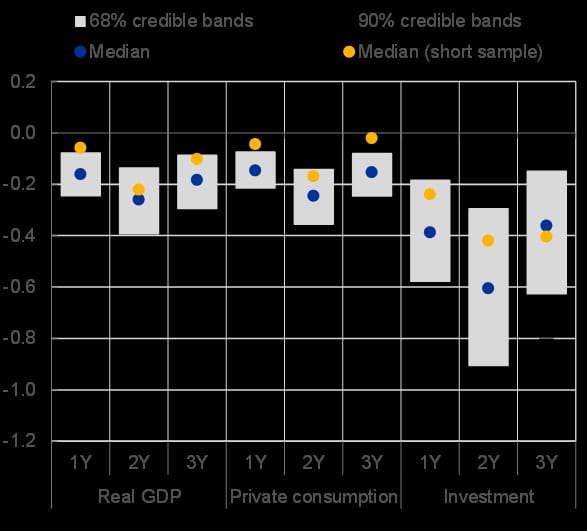
ECB staff analysis using a Bayesian vector autoregressive (VAR) model estimated that a 10% increase in the real oil price could reduce euro area real GDP growth by 0.2 to 0.3 percentage points annually for the first three years following the shock. This adverse impact is more pronounced on investment due to heightened uncertainty associated with geopolitical oil supply disruptions. However, the analysis also suggested that the oil intensity of the euro area economy has declined, potentially weakening the effects of such shocks over time, particularly on private consumption.
In a separate address, ECB President Christine Lagarde stated that the central bank's response to the current economic shock would be guided by its monetary policy strategy. This involves assessing the nature, size, and persistence of the shock, identifying when higher energy costs risk spilling over into broad-based inflation, and focusing on risks beyond the baseline scenario. Lagarde noted that while small, one-off, and short-lived supply shocks can often be overlooked, persistent deviations from the inflation target would strengthen the case for policy action.
Historical ECB research indicates that the risk of broad pass-through from energy prices to general inflation in the euro area is typically the exception rather than the rule. This pass-through is more likely to occur when shocks are large and persistent, or when the macroeconomic environment, such as high capacity utilization and tight labor markets, facilitates it.