Key facts
- Chinese startups are exhibiting advanced humanoid robots and AI at the World Robot Conference in Beijing.
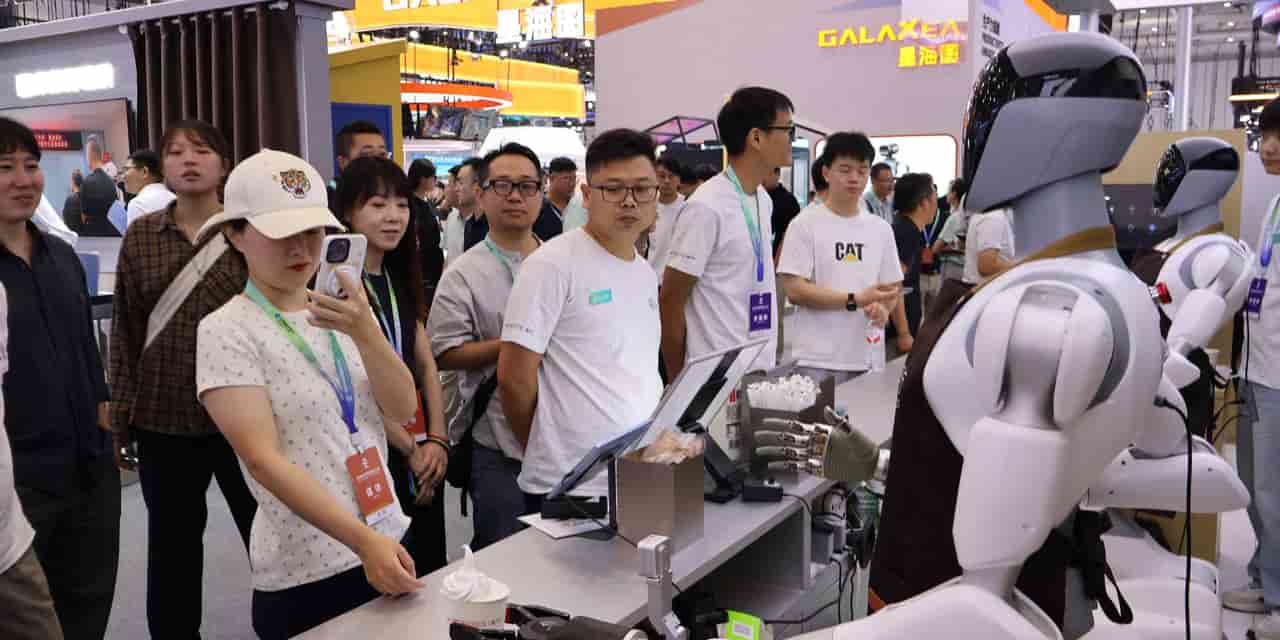
- AI2 Robotics' AlphaBot, powered by its own foundation AI model, demonstrated ice cream making.
- China's robotics sector is rapidly localizing its hardware supply chain, though it still relies on Nvidia's AI chips.
- The government is actively promoting robotics through policies and funding, aiming for deep integration of AI into society.
- Current Chinese humanoids are cheaper than Western counterparts but lack precision and are too expensive for broad deployment.
Chinese technology firms are increasingly showcasing advanced robotics and artificial intelligence at major expos in Beijing, signaling an ambitious push to transform the nation's industrial landscape and attract investment. At the 2026 World Robot Conference, startups like Shenzhen-based AI2 Robotics demonstrated their capabilities, with its AlphaBot, powered by a proprietary foundation AI model, serving ice cream to visitors.
The development aligns with China's broader strategy to deepen AI integration into its economy and society, as highlighted in its 15th Five-Year Plan. The government is actively promoting robotics through national policies and funding, aiming to maintain entire industrial value chains within the country. China's significant industrial robotics base, bolstered by its leading position in electric vehicles (EVs), provides a strong foundation for developing 'embodied AI'—autonomous agents capable of complex real-world actions.
However, challenges remain. Despite being cheaper than Western competitors, Chinese humanoid robots currently lack the precision and dexterity for widespread autonomous deployment. Their high cost also presents a barrier to commercial viability, with prices needing to fall substantially. The sector's reliance on Nvidia's AI chips and software ecosystem is also a point of focus, though China is rapidly localizing its hardware supply chain.
Beijing's drive for AI diffusion is seen as a strategic imperative to boost economic and military power, even as it navigates potential structural risks to the labor market. European companies are warned to prepare for intense competition, potentially mirroring the dynamics seen in the EV market, as China leverages its industrial capacity and state support to advance in robotics.