All NewsEducationTVBrokers
Equities & FundsCrypto & Digital AssetsAI & TechnologyBusiness & CorporateUS Politics & PolicyGeopolitics & Global RiskMacro, Rates & FXCommodities & EnergyEuropean Politics & MarketsAsia-PacificReal Estate & Property
All NewsHome
← Back to Commodities & Energy

China's top airlines post heavy first-half losses on soaring fuel costs

Created at 31 Aug · 2:56 AM1 source↑ Market-relevant
IN SHORT

China's three largest state-owned airlines reported significant first-half losses, marking seven consecutive years of deficits. Surging jet fuel prices, exacerbated by the Middle East conflict, severely impacted profitability, with a weak summer travel season further clouding the outlook.

Key Numbers

8.2 billion yuancombined first-half net losses
$1.22 billioncombined first-half net losses
4.82 billion yuancombined first-quarter profit
2.3 billion yuanAir China's net loss
1.81 billion yuanAir China's loss a year earlier
2.2 billion yuanChina Eastern's net loss
1.43 billion yuanChina Eastern's loss a year earlier
3.7 billion yuanChina Southern's net loss
1.53 billion yuanChina Southern's loss a year earlier
35%minimum fuel cost increase
38%maximum fuel cost increase
10.5%Air China revenue growth
11.1%China Eastern revenue growth
9.7%China Southern revenue growth
50%jet fuel prices above pre-war levels
21typhoons formed this year
9more than average typhoons
3.6%projected traffic fall
142 millionprojected passengers
16.8 billion yuanforecasted combined losses for 2026
1.3 billion yuanmarket expectation for 2026 profit
36%minimum share price fall year-to-date
17China Eastern's COMAC C919 fleet
11Air China's COMAC C919 fleet
11China Southern's COMAC C919 fleet
13fewer C919 deliveries forecast

Who's Involved

Air China
state-owned airline reporting a net loss
China Eastern Airlines
state-owned airline reporting a net loss
China Southern Airlines
state-owned airline reporting a net loss
HSBC
analysts forecasting airline losses
Julie Zhu
Reuters reporter
Sophie Yu
Reuters reporter
Jamie Freed
Reuters editor
China's top airlines post heavy first-half losses on soaring fuel costs

↳ Why This Matters

The significant losses reported by China's major airlines highlight the ongoing fragility of the aviation sector, demonstrating how volatile commodity prices, particularly jet fuel, can severely impact profitability even with strong revenue growth. This situation affects investor confidence and the broader economic outlook for China's travel industry.

Key facts

  • China's three largest state-owned airlines, Air China, China Eastern Airlines, and China Southern Airlines, reported combined first-half net losses of approximately 8.2 billion yuan ($1.22 billion).
  • The losses were attributed to a severe increase in jet fuel prices, which rose 35%-38% for the carriers in the first half.
  • Despite strong revenue growth driven by international demand, the airlines were unable to pass on costs due to weaker economic conditions and competition from high-speed rail.
  • A strong typhoon season disrupted domestic travel during the peak summer period, further impacting profitability.
  • Analysts predict the three airlines will post combined losses of around 16.8 billion yuan in 2026, with their shares already down significantly this year.

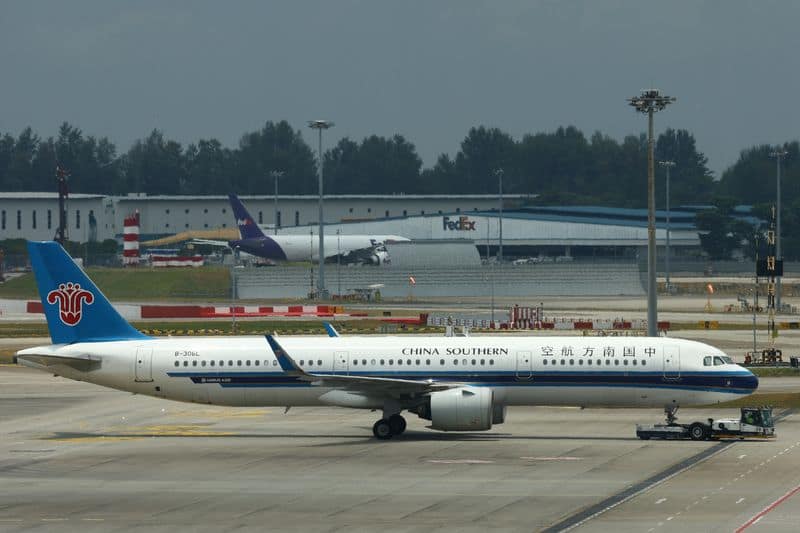
China's three largest state-owned airlines, Air China, China Eastern Airlines, and China Southern Airlines, have reported substantial net losses for the first half of the year, extending a streak of deficits to seven consecutive years. The combined losses amounted to approximately 8.2 billion yuan ($1.22 billion), a stark contrast to their first-quarter profit, which had been bolstered by strong Lunar New Year demand.

The primary driver for these losses was a significant surge in jet fuel prices, which rose between 35% and 38% for the carriers. This increase is linked to the ongoing conflict in the Middle East. Unlike many international competitors, Chinese airlines engage in minimal fuel hedging, leaving them highly exposed to oil price volatility. China Southern noted in its filing that there were currently "no effective means available" to manage this exposure.

Despite robust revenue growth, with Air China up 10.5%, China Eastern up 11.1%, and China Southern up 9.7%, driven by international travel demand, the airlines struggled to translate this into profits. They faced challenges in raising domestic fares due to weaker economic conditions and competition from high-speed rail, unlike the U.S. market. Jet fuel prices, though down from their second-quarter peak, remain over 50% higher than pre-war levels.

The third quarter, typically the most profitable, has also been challenging due to an unusually active typhoon season disrupting domestic routes during the peak summer travel period. Aviation data firm Flight Master projected a 3.6% year-on-year decrease in passenger traffic for July and August, marking the first contraction in this peak season since the pandemic lockdowns of 2022.

Hebank analysts anticipate that the three carriers will collectively lose around 16.8 billion yuan in 2026, a significant downward revision from previous expectations of a 1.3 billion yuan profit. The Shanghai-listed shares of all three airlines have fallen by at least 36% in 2026, reflecting the persistent pressure on their profit outlooks from weaker domestic travel demand. None of the airlines declared an interim dividend.

In fleet developments, the trio continued to expand their holdings of domestically manufactured COMAC jets. China Eastern received three C919 deliveries in the first half, bringing its fleet to 17. Air China and China Southern each operate 11 C919s, having taken two and three deliveries respectively. China Eastern expects 13 fewer C919 deliveries between 2026 and 2028 than previously forecast, while Air China maintained its forecast and China Southern did not disclose its outlook.

Frequently asked questions

The combined net losses for Air China, China Eastern Airlines, and China Southern Airlines in the first half were approximately 8.2 billion yuan ($1.22 billion).

The primary reason was a sharp increase in jet fuel prices, which rose between 35% and 38% for the carriers, exacerbated by the Middle East conflict and a lack of fuel hedging.

Revenue growth was strong, with Air China up 10.5%, China Eastern up 11.1%, and China Southern up 9.7%, driven by international demand.

The outlook is clouded by a lackluster summer season due to typhoon disruptions and weaker economic conditions hindering domestic fare hikes. Analysts forecast significant losses for 2026.

What Happens Next

01Aviation data firm Flight Master projected traffic carried by Chinese airlines on domestic and international routes would fall 3.6% year-on-year to 142 million passengers in July and August.
02HSBC analysts expect China's three biggest carriers to post combined losses of about 16.8 billion yuan in 2026.
CME Headlines
  • RBOB Gasoline futures reach multi-month highs on inventory draw.
    28 Aug · 10:40 PM
  • RBOB Gasoline futures reach multi-month highs on inventory draw.
    28 Aug · 10:40 PM
  • Live Cattle futures slide for 4th straight week as Lean Hogs rebound.
    28 Aug · 10:24 PM

How It Developed

China's three largest state-owned airlines reported combined first-half net losses of approximately 8.2 billion yuan.
The losses represent a sharp reversal from a combined first-quarter profit of 4.82 billion yuan.
Air China, China Eastern Airlines, and China Southern Airlines reported individual net losses of 2.3 billion, 2.2 billion, and 3.7 billion yuan, respectively.
Fuel costs for the carriers increased between 35% and 38% in the first half.
Revenue growth was strong, driven by international demand, particularly on European routes.
Typhoon disruptions during the peak summer travel period reduced domestic passenger traffic.
HSBC analysts forecast combined losses of about 16.8 billion yuan for the three carriers in 2026.
Shares of the three carriers have fallen at least 36% year-to-date in 2026.

Sources

T1
China's three biggest airlines post heavy first-half losses as fuel shock bitesReuters

Related Stories

Hong Kong aims to become global precious metals trading hub
31 Aug · 1:06 AM
Saudi Arabia Backs Turkey’s Renewable Energy Expansion
30 Aug · 3:21 PM
AI Boom Fuels Surge in U.S. Natural Gas Power Plant Development
30 Aug · 7:41 PM
South West Water cited for worst environmental record in England
30 Aug · 6:11 AM