Key facts
- China's TianGong Ultra robot ran 100 meters in 8.64 seconds, faster than Usain Bolt's record.
- Jack Guo leads development of TianGong Ultra and Omni robots at Beijing Humanoid Robot Innovation Centre (X-Humanoid).
- X-Humanoid is backed by state-owned and private investors including UBTech, Xiaomi, and Baidu.
- Robots have been trialed at Foton Cummins' engine factory for moving boxes.
- The company aims to develop AI for complex autonomous tasks, with smaller humanoids expected in commercial services and light industry.
- Ultra weighs 75kg and can exceed 17 meters per second, posing braking challenges.
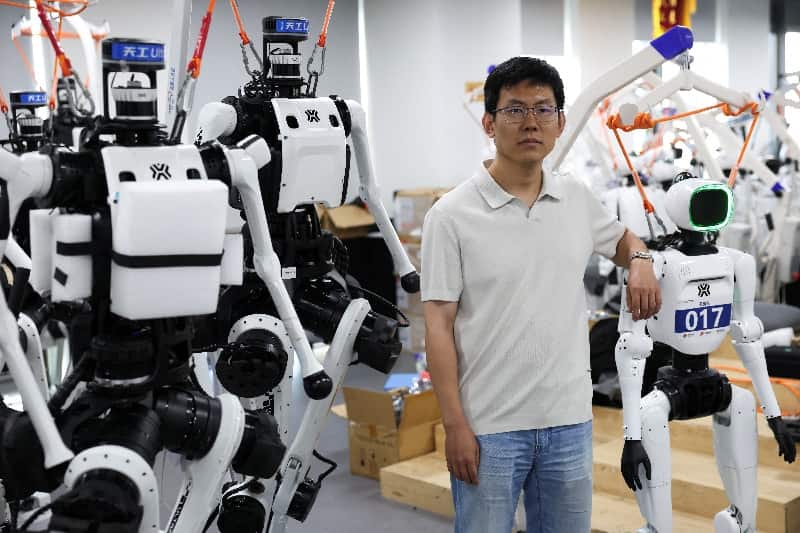
A week after its humanoid robot TianGong Ultra outran Usain Bolt's 100-meter world record, its developers are shifting focus from speed to practical application. Jack Guo, lead developer at the Beijing Humanoid Robot Innovation Centre (X-Humanoid), aims to transform the robot's high performance into reliability and usability for real-world tasks.
X-Humanoid, established in November 2023 and backed by state-owned and private investors including UBTech, Xiaomi, and Baidu, is situated in Beijing's Yizhuang high-tech development zone. The center develops hardware, motion-control software, and AI for the robotics industry while commercializing its own robots. During a Reuters visit, engineers were seen repairing and testing the robots, including the Ultra and a smaller model called Omni.
Guo likens the current stage of humanoid robots to early automobiles, emphasizing the need for stable bodies and reliable movement control before integrating smarter AI for complex tasks. The company has trialed its Tianyi 2.0 robot at Foton Cummins' engine factory for tasks like lifting boxes. Guo anticipates smaller humanoids will find roles in commercial services and light industry, while larger models like Ultra could eventually be used for outdoor inspection or emergency rescue.
The record-breaking run at the World Humanoid Robot Games involved three trained running strategies, with Ultra achieving its fastest time of 8.64 seconds in the final. Engineers worked through the night to refine programs and adjust navigation, facing challenges with robots stumbling, losing balance, and crashing. Guo noted that even on the morning of the final, a new program tested well in trials but did not perform as expected on the competition track. Ultra's heavier legs initially limited acceleration but allowed it to build speed and overtake rivals in the final race.