Key facts
- AI is restructuring corporate jobs, leading to a reduction in middle management.
- The trend promotes flexible human-machine collaboration.
- Employers are freezing or reducing external recruitment for entry-level positions.
- Macro employment and unemployment rates remain stable.
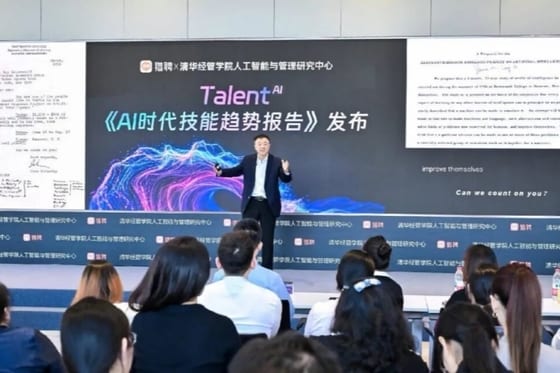
- The 'Talent AI: Skills Trend Report in the AI Era' was launched at Tsinghua University.
Artificial intelligence is fundamentally restructuring the global job market, leading to a reduction in corporate middle management and a shift toward flexible, human-machine collaboration, according to industry leaders and academics. The insights were shared at a conference at Tsinghua University on June 17, marking the launch of the 'Talent AI: Skills Trend Report in the AI Era.'
Experts at the event, which was jointly hosted by recruitment platform Tongdao Liepin and Tsinghua University's School of Economics and Management, emphasized that AI is no longer just a supplementary technology but a transformative force that is redefining business models and the very nature of work itself. According to Zhang Dandan, a professor at Peking University’s National School of Development, AI's impact on employment is primarily seen in employers freezing or reducing external recruitment for new, entry-level positions, rather than mass layoffs of existing staff. She noted that macro employment and unemployment rates remain stable, and affected workers can often find new jobs quickly, preventing extended unemployment cycles.