Key facts
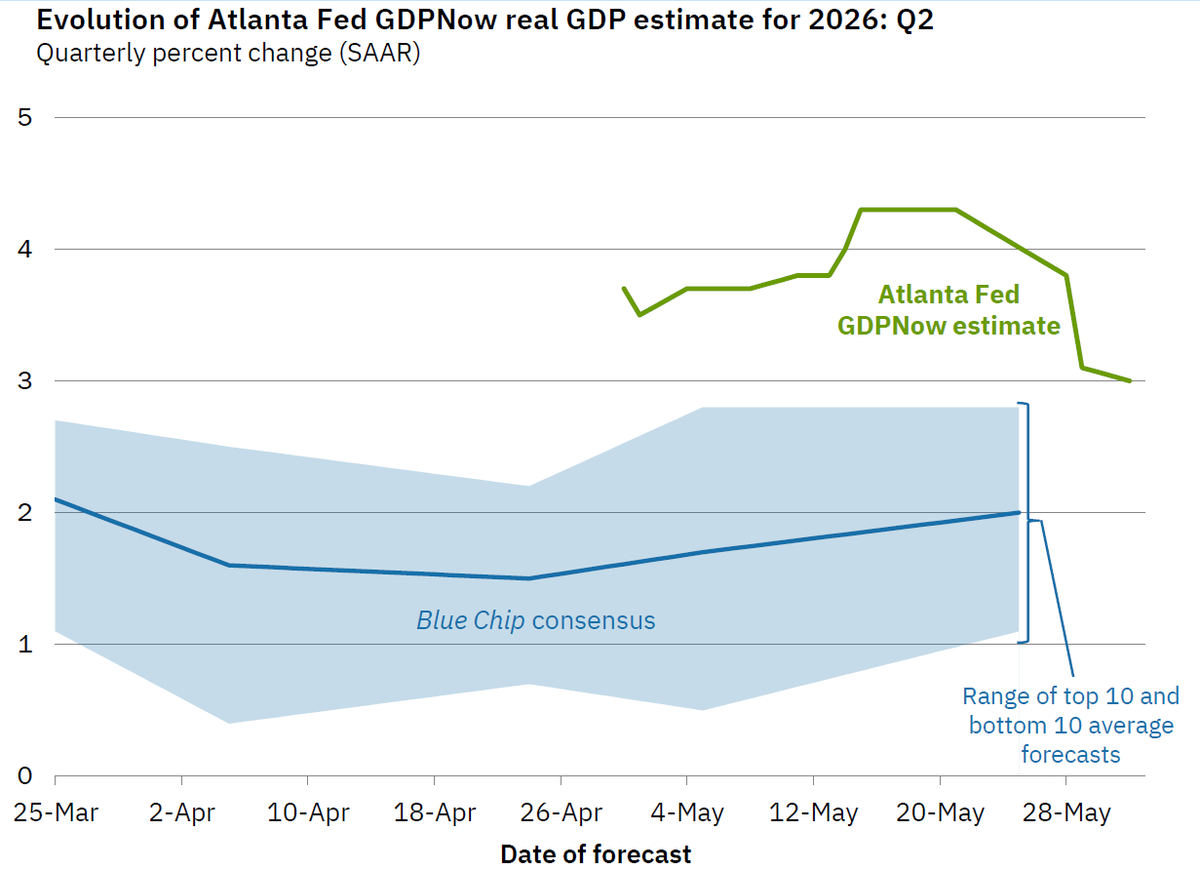
- The Atlanta Fed's GDPNow model estimates Q2 real GDP growth at 3.0%.
- U.S. consumer sentiment fell to 42.5 in June, remaining below the neutral 50 threshold.
- U.S. retail sales rose 9.0% year-over-year in the final week of May.
- India's industrial production increased by 4.9% in April.
- Canada's economy has entered a technical recession.
- Israel's deficit is projected to exceed the ceiling in 2029, requiring NIS 15.7bn in savings.
- NY Fed updated r-star estimates through Q1 2026 using specific models.
The U.S. economy presents a complex picture with conflicting indicators. The Atlanta Federal Reserve's GDPNow model now forecasts actual Q2 real GDP growth at 3.0%, a downward revision from its prior estimate of 3.8%. Concurrently, U.S. consumer sentiment remains subdued. The RCM/TIPP Economic Optimism Index for June registered 42.5, a 0.1-point decrease from the previous month. This marks the tenth consecutive month the index has remained below the 50-point threshold, indicating pessimism, and is 13.4% below its long-run average. However, U.S. retail activity shows robust growth. The Redbook Retail Sales Index increased by 9.0% year-over-year in the final week of May, matching the growth rate of the preceding week. This suggests a significant acceleration in retail spending during the first two months of the second quarter of 2026, outpacing growth rates observed in 2024 and 2025.
Internationally, India's industrial production saw a notable increase in April, rising by 4.9%. This figure surpassed the forecasted 3.8% and represents an acceleration from the 4.1% growth recorded in the previous month. The data encompasses output from the manufacturing, mining, and electricity sectors. In contrast, Canada's economy has entered a technical recession. Prime Minister Mark Carney commented that the government's economic plan is "settling in," and he attributed the economic weakness to policy decisions implemented to counteract U.S. tariffs.
Further economic projections and modeling updates have also been released. Israel's Finance Ministry has issued a 3-year fiscal projection update. The ministry anticipates the deficit will exceed the permitted ceiling only in 2029, necessitating NIS 15.7 billion in savings. Projections indicate a deficit of 2.5% of GDP for 2027-2028, rising to 3.0% in 2029, which is above the 2.4% ceiling. The ministry noted a significant increase in the weight of defense and interest spending compared to pre-war levels. Additionally, the New York Fed Research has updated its estimates for r-star, the natural rate of interest, and related variables. These updated projections now extend through the first quarter of 2026 and employ the Laubach-Williams and Holston-Laubach models.