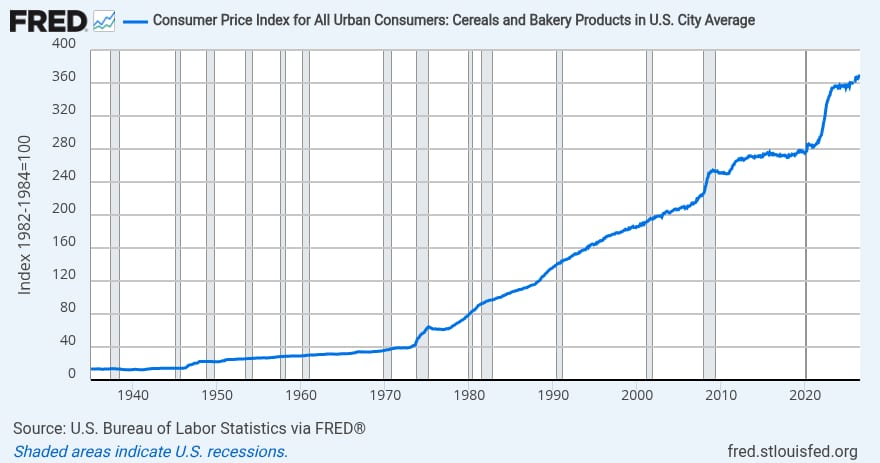
Key facts
- The Consumer Price Index for baked foods and cereal products increased by 0.3% in July.
- The index for baked foods and cereal products saw a 0.9% increase in 2025, following a 0.5% gain in 2024.
- The price index for Bakery Products advanced 1.6% in 2025, while the CPI for Cereals and Cereal Products decreased 0.6% in the same year.
- On a monthly basis, the CPI for baked foods and cereal products rose 0.2% in December.
- Overall inflation remains above the Federal Reserve's 2% target.
The Consumer Price Index (CPI) for baked foods and cereal products showed a modest increase in July, rising by 0.3%. This data reflects broader trends in food inflation, which continues to challenge consumers and remains above the Federal Reserve's target rate.
According to data from the Bureau of Labor Statistics, the index for baked foods and cereal products regained some momentum in 2025, increasing by 0.9% after a 0.5% gain in 2024. This followed significant increases in prior years, including 8.4% in 2023 and 13% in 2022. The gains in grain-based foods were comparable to other food categories, with meats, poultry, fish, and eggs increasing by 5.8% in 2025, and fruits and vegetables rising by 0.2%.
Breaking down the categories, the price index for Bakery Products advanced 1.6% in 2025, with bread increasing by 0.8% and cakes, cupcakes, and cookies rising by 2%. However, the CPI for Cereals and Cereal Products decreased by 0.6% in 2025, marking its second consecutive year of decline. Within this segment, flour and prepared mixes advanced, while breakfast cereal saw a slight increase and rice, pasta, and corn meal decreased.
On a monthly basis, the CPI for baked foods and cereal products rose 0.2% in December. The index for Cereals and Cereal Products in December was down 0.3% from November, while the price index for Bakery Products was up 0.4% from the previous month. Data for October and November was incomplete due to a government shutdown in late 2025.
Andy Harig, vice president at FMI -- The Food Industry Association, commented that the CPI numbers reflect the ongoing challenge of controlling food inflation. He noted that overall inflation remains stubbornly above the Federal Reserve's 2% target and expressed hope that some of the December figures might be holiday-related and could stabilize in 2026, while acknowledging the continued pressure on consumers' budgets.