Key facts
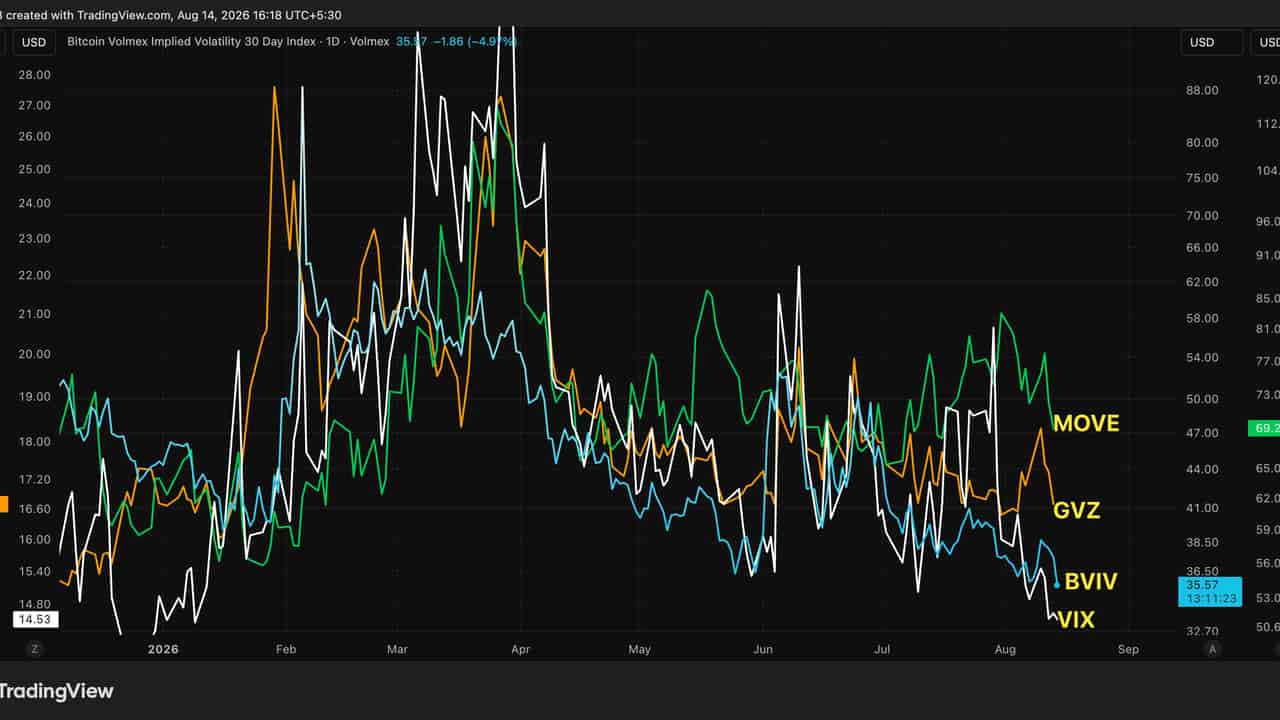
- Implied volatility across Bitcoin, Ether, S&P 500, U.S. Treasuries, gold, and oil markets has decreased significantly.
- Bitcoin's 30-day implied volatility (BVIV) is near a 2026-low of 36%.
- The VIX index, tracking S&P 500 volatility, is at its lowest point since January.
- The MOVE index for U.S. Treasuries is near the lower end of its multi-month range.
- U.S. Treasury yields increased, with the 10-year reaching 4.661%, following U.S. threats of further sanctions on Iran.
Despite lingering geopolitical tensions between the U.S. and Iran, rising sovereign debt, and increasing bond yields, major financial markets are experiencing a notable decline in volatility. Bitcoin's 30-day implied volatility index (BVIV) has fallen to a 2026-low near 36%, a trend mirrored by Ether. On Wall Street, the VIX index, a key measure of S&P 500 volatility, has reached its lowest point since January. Similarly, the MOVE index, which tracks Treasury market volatility, is hovering near the lower end of its multi-month range, and even gold and oil volatility indexes are showing declines.
This broad-based calm across asset classes, including crypto, stocks, bonds, and commodities, is reflected in their respective implied volatility readings. Implied volatility, derived from options and derivatives demand, indicates expected price turbulence. While an efficient-market proponent might trust this market calmness, contrarian traders may view this synchronized low-volatility environment as a precursor to a significant market event.
Concurrently, U.S. Treasury yields saw an increase, with the 10-year yield rising to 4.661%, following U.S. threats to continue naval blockades of Iranian ports indefinitely. Global stocks, however, remain near record highs, supported by benign U.S. inflation data that has tempered expectations for an imminent interest-rate hike by the Federal Reserve. Meanwhile, oil prices edged higher due to stalled talks aimed at resolving the conflict in the Middle East.