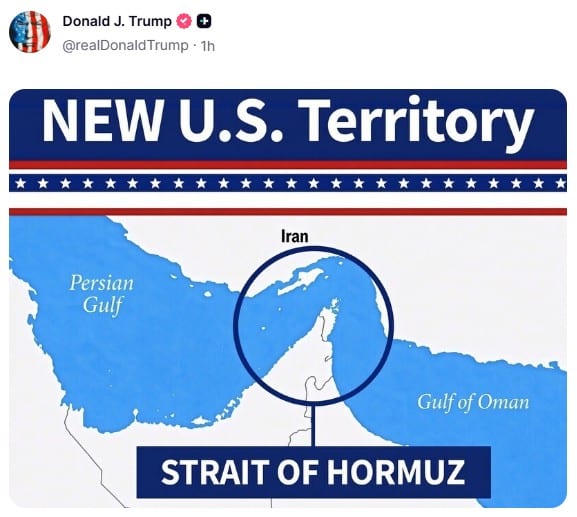
Trump labels Strait of Hormuz 'New US Territory' on social media | PiQ Markets
breaking
4 storiesGeopolitics & Global RiskMiddle East conflict (Israel-Gaza, Lebanon, Iran)Shipping lane security (Hormuz, Bab-el-Mandeb, Red Sea, South China Sea)
Trump labels Strait of Hormuz 'New US Territory' on social media
window 24h
IN SHORT
President Donald Trump has declared the Strait of Hormuz "New US Territory" on social media, escalating tensions with Iran. Iran's top negotiator responded that the Strait will remain closed until the U.S. meets unspecified deal conditions, including sanctions relief. The Islamic Revolutionary Guard Corps (IRGC) also dismissed Trump's claims of backchannel talks as "delusions." Meanwhile, China is increasing its use of the Arctic's Northern Sea Route as an alternative to traditional trade paths due to escalating Middle East tensions and threats to Red Sea shipping.
Who's Involved
Donald Trump
U.S. President posting maps and claims on social media
Iran
Nation whose negotiator stated the Strait of Hormuz will remain closed
Islamic Revolutionary Guard Corps (IRGC)
Iranian military organization dismissing claims of backchannel talks
China
Nation increasing use of Arctic shipping routes
Russia
Nation managing the Arctic's Northern Sea Route
1 / 4
Key facts
President Donald Trump labeled the Strait of Hormuz "New US Territory" on social media.
Iran's top negotiator stated the Strait of Hormuz will remain closed until U.S. deal conditions are met.
Iran's interim deal conditions include lifting U.S. sanctions and blockades.
Oil prices rose as prospects for a Middle East war deal receded.
Iran's IRGC dismissed claims of backchannel talks as "fantasies" and "delusions."
The IRGC cited broken U.S. promises and agreement violations for lack of dialogue.
China is increasing its use of the Arctic's Northern Sea Route.
China's shift is driven by escalating Middle East tensions and threats to Red Sea shipping.
Melting Arctic ice and China's relations with Russia are factors in China's route choice.
President Donald Trump has posted a map on Truth Social labeling the Strait of Hormuz as "New US Territory." This action escalates rhetoric surrounding the strategic waterway amidst ongoing tensions and expired negotiation periods between Washington and Tehran. In response, Iran's top negotiator stated that the Strait of Hormuz will remain closed until the U.S. meets interim deal conditions. These conditions reportedly include lifting sanctions and blockades imposed by Washington. The prospect of a deal to end the Middle East war has receded, leading to a rise in oil prices. Further complicating the situation, Iran's Islamic Revolutionary Guard Corps (IRGC) has dismissed claims made by President Donald Trump regarding backchannel talks. The IRGC characterized these claims as "fantasies" and "delusions," citing broken U.S. promises and violations of previous agreements as reasons for the absence of dialogue. Amidst these escalating Middle East tensions and threats to traditional shipping routes like the Red Sea, China is increasing its utilization of the Arctic's Northern Sea Route. This strategic shift is driven by factors including melting Arctic ice and China's favorable relations with Russia, which manages the Northern Sea Route, positioning it as an alternative to conventional trade paths.
Frequently asked questions
The Strait of Hormuz is a narrow waterway connecting the Persian Gulf and the Gulf of Oman, crucial for global oil and gas shipments.
Approximately 20% of the world's oil and liquefied natural gas supply normally passes through the Strait of Hormuz, making it a critical global energy chokepoint.
Iran considers the Strait of Hormuz its territory and has stated it will only be closed and opened under Iran's command. They have linked its reopening to the US fulfilling commitments such as lifting sanctions and releasing frozen assets.
President Donald Trump posted an image on social media labeling the Strait of Hormuz as 'New US Territory,' a provocative claim amid ongoing conflict.
What Happens Next
01Finalization of details for a joint statement between Iran and Oman regarding transit routes.
02Continued monitoring of traffic and security in the Strait of Hormuz.