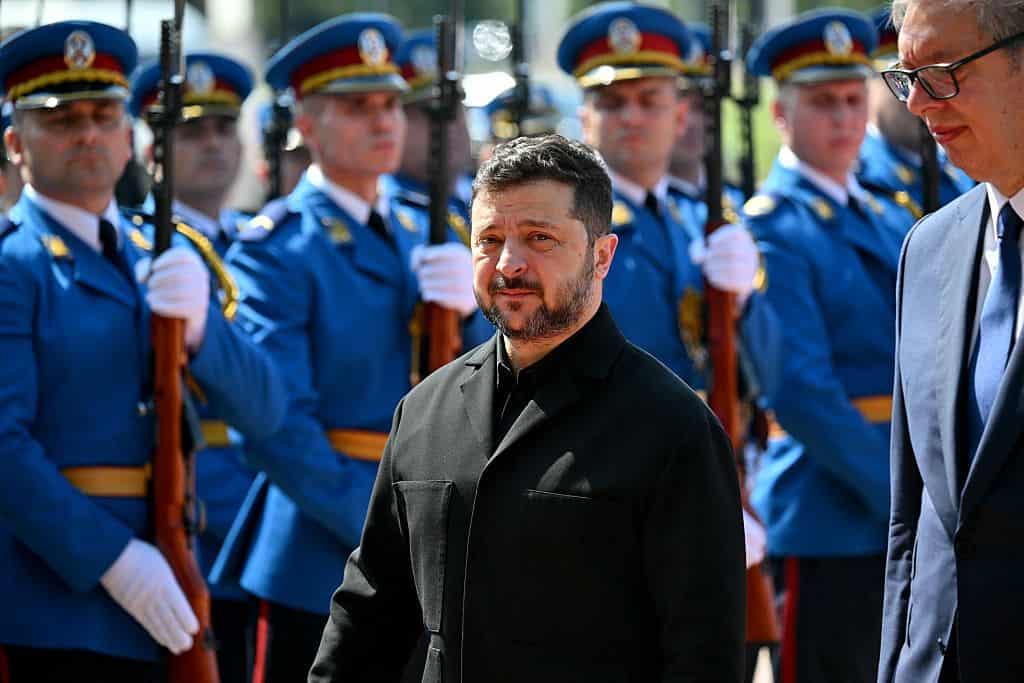
Key facts
- Ukrainian President Volodymyr Zelensky visited Serbia, the first such visit by a Ukrainian head of state since 2018.
- Serbia respects Ukraine's territorial integrity, a stance that has drawn criticism regarding Kosovo.
- Serbia is set to open a drone factory in September as a joint venture with Israeli defense group Elbit Systems.
- Serbia has been a significant supplier of ammunition to Ukraine through third countries, despite official denials of direct supply.
- President Vucic is navigating domestic political pressure and EU scrutiny, using the visit to signal alignment with Western policies.
President Volodymyr Zelensky's visit to Serbia, the first since 2018, signals a potential shift in relations between the two nations and raises questions about mutual gains. Serbia, which has not imposed sanctions on Russia, is a key energy supplier to Moscow and has historically maintained a delicate balance between East and West.
During a joint press conference, Serbian President Aleksandar Vucic stated that no military cooperation was discussed, but acknowledged future possibilities post-war. Political analysts suggest Zelensky's visit aims to isolate Russia further by engaging a country perceived as part of Moscow's sphere of influence. For Vucic, the visit is seen as an effort to align with European policy towards Ukraine while seeking progress in Serbia's EU accession talks.
Both presidents reaffirmed respect for each other's territorial integrity. However, Zelensky's remarks on this matter drew criticism from Pristina and Tirana, and within Ukraine, with some lawmakers calling it a "diplomatic blunder." This position is attributed to Ukraine's reluctance to recognize Kosovo's independence, given Russia's use of the Kosovo precedent to justify its annexation of Crimea.
A significant development announced by Vucic was Serbia's upcoming drone factory, a joint venture with Israeli defense group Elbit Systems and Serbia's Yugoimport SDPR, set to produce sophisticated attack drones. While no direct defense deal was announced, Vucic invited Zelensky to the factory's launch, hinting at future cooperation.
Serbia's defense industry, a legacy of Yugoslavia, is export-oriented. Despite Vucic's claims of not directly supplying weapons to Kyiv, Serbian-made ammunition has reportedly reached Ukraine through third countries, estimated at 800 million euros since Russia's full-scale invasion. This makes Serbia an important supplier of Soviet-style ammunition, a key issue for Zelensky.
Vucic has faced domestic pressure, including large anti-government protests and criticism from the European Commission regarding reforms. The visit is viewed as part of his strategy to project an image of alignment with the West, potentially aiding Serbia's stalled EU accession process and deflecting from domestic political challenges.