Key facts
- Russia conducted a missile and drone attack on Kyiv on June 15, 2026.
- The Dormition Cathedral at the Kyiv Pechersk Lavra was damaged.
- The attack evoked memories of the cathedral's destruction by Soviet forces in 1941.
- The Lavra has been a significant religious and cultural center since 1051.
- The site has historically been a target of Russian influence and control.
- Ukraine transferred the Lavra from the Moscow Patriarchate to the Ukrainian Orthodox Church in 2023.
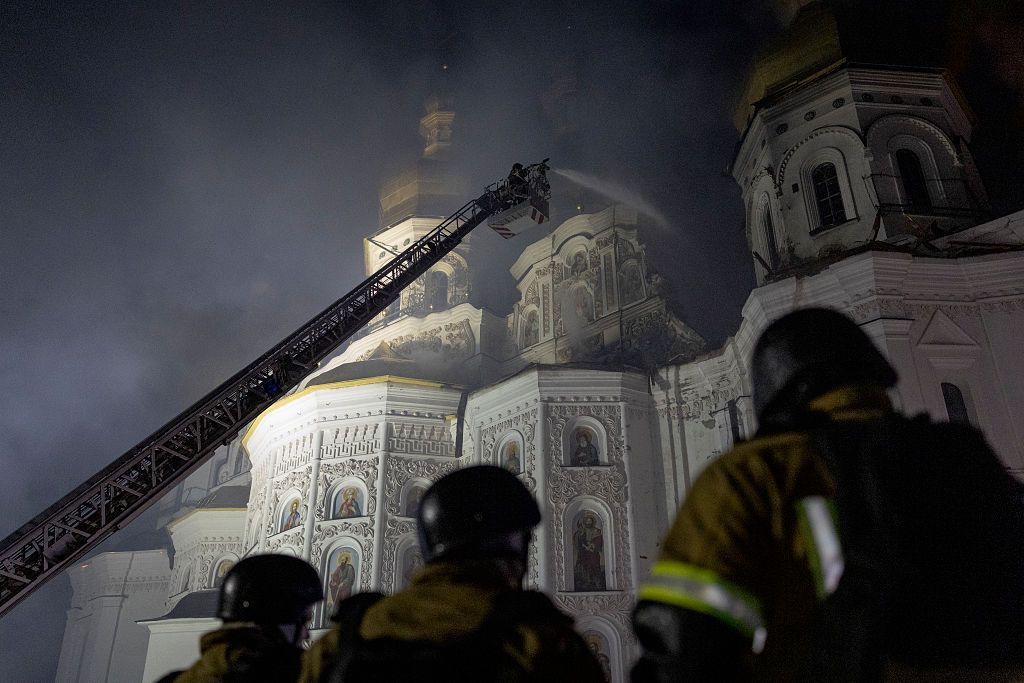
The historic Kyiv Pechersk Lavra, one of Orthodox Christianity's most sacred sites, was damaged in a large-scale Russian missile and drone attack on Kyiv on June 15, 2026. The Dormition Cathedral, a central part of the monastery complex, was seen engulfed in flames, drawing widespread condemnation.
The Security Service of Ukraine identified the attack as involving a Russian Shahed-type drone. This is not the first time the Lavra has been damaged since the full-scale invasion began; a previous attack in late January caused blast wave damage to several buildings and caves on the monastery grounds.
The sight of the Dormition Cathedral burning evokes a level of destruction not seen since World War II, when Soviet forces detonated explosives in the cathedral as they retreated from German troops in November 1941. The cathedral was fully rebuilt and reconsecrated in 2000.
Founded in 1051 by Anthony of Kyiv, the Lavra has evolved into a significant religious sanctuary and a hub for intellectual and cultural exchange, historically oriented towards Europe. It played a crucial role in preserving Ukrainian culture and identity, especially during periods when Ukraine lacked statehood. The first book printed in Kyiv in 1616 originated within its walls, and it was a center for philosophical, theological, and artistic development, including the establishment of the Kyiv Mohyla Academy.
In 1686, the Kyiv Metropolitanate's jurisdiction was transferred to the Moscow Patriarchate, marking the beginning of increased Russian ecclesiastical influence and the promotion of a revisionist history aimed at weakening Ukrainian identity. Despite these efforts, the Lavra continued to ensure the continuity of Ukrainian history and culture, accumulating numerous relics and artifacts that make it one of Ukraine's largest museums.
During Soviet times, the monastery grounds were temporarily used as an anti-religious propaganda museum, and Metropolitan Volodymyr of Kyiv was murdered there by Bolshevik troops in 1918. In the late 1980s, as the Soviet Union neared collapse, part of the Lavra was transferred to the Ukrainian Orthodox Church of the Moscow Patriarchate, which critics argue became an instrument of Russian colonialism, using the rebuilt shrine to promote the ideology of the 'Russian world.'
Scandals involving Metropolitan Pavlo, the former head of the Lavra under the Moscow Patriarchate, highlighted the weaponization of religion for political purposes, with his pro-Russian views and justification of Russian aggression leading to charges of inciting interreligious hatred. In 2023, Ukraine officially ended the Moscow Patriarchate's lease on the Lavra, transferring it to the Ukrainian Orthodox Church and holding the first services in Ukrainian in years.
Ukraine's Culture Minister Tetiana Berezhna stated that the attack underscores Russia's willingness to destroy what it cannot control, emphasizing that the destruction of cultural heritage is an attack on Ukrainian identity and resilience.