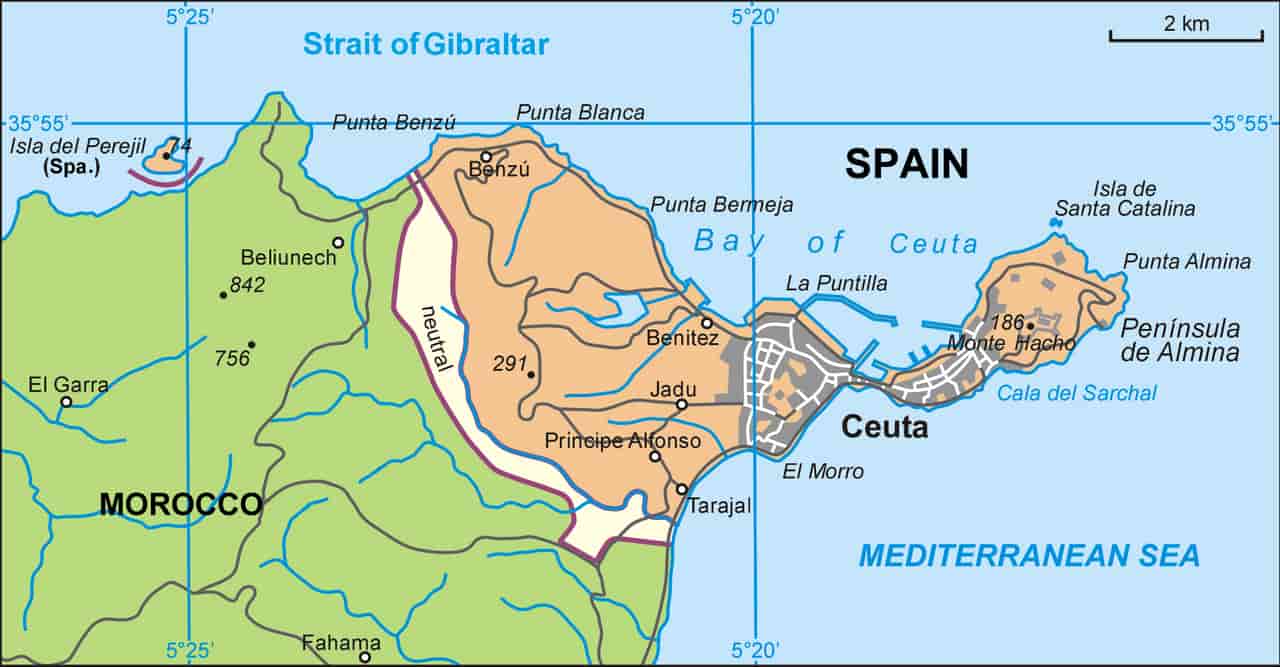
Dozens of migrants who crossed into the Spanish enclave of Ceuta from Morocco have reached mainland Spain. The influx into Ceuta has overwhelmed local facilities, with thousands of people attempting to cross.

The large-scale migrant crossings into Ceuta highlight ongoing humanitarian challenges at Europe's external borders and underscore the complex geopolitical relationship between Spain and Morocco, with potential implications for EU migration policy and regional stability.
An estimated 80,000 people, primarily young men, have illegally crossed the border from Morocco into the Spanish autonomous city of Ceuta since late July 2026, with smaller numbers attempting to reach Melilla. This significant influx has overwhelmed local reception facilities, prompting the government of Ceuta to request a national emergency declaration from the Spanish government.
Most migrants entered Ceuta by swimming around breakwaters or by crossing on foot along the shoreline. By August 3, Spanish government officials stated that approximately 70,000 people had voluntarily returned to Morocco. Thousands of migrants, largely from sub-Saharan Africa, are estimated to still be remaining in Spain. The incident has resulted in at least 111 reported migrant deaths, with 100 in Ceuta and 11 in Fnideq, Morocco.
Ceuta and Melilla are Spanish autonomous cities located on the north coast of Africa, forming the EU's only external land border in Africa. Their location makes them frequent focal points for migrant entry into Spain and the EU. Morocco has previously exerted political pressure on Spain by temporarily increasing border permeability. The root causes cited for the migration include economic opportunity, climate change, social inequality, and repressions in Morocco, with high youth unemployment and dissatisfaction with the country's economy, public services, and governance.