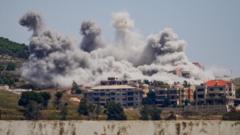
Hezbollah has rejected a ceasefire plan that was agreed upon by the Lebanese and Israeli governments following US-mediated talks. The group's leader, Naim Qassem, described the plan as 'shameless' and a 'roadmap for the annihilation of a section of the Lebanese people and the enslavement of the rest.' He asserted that Hezbollah's resistance would continue as long as the occupation persists. Hostilities between Hezbollah and Israel had reignited on March 2, with the group opening fire in support of Iran. Despite several declared ceasefires since April, the conflict has continued. Qassem stated that a ceasefire must include southern Lebanon, where Israel has established a self-declared security zone, and that northern Israeli towns would not be secure as long as Lebanese villages are unsafe and their people are killed. The commander of Iran's Revolutionary Guards Quds Force, which established Hezbollah in 1982, demanded that Israel withdraw to its pre-war positions. Meanwhile, Israeli Defense Minister Israel Katz stated that Israel would continue to strike Lebanon for the time being, and the Israeli military warned residents of southern Lebanon that it was continuing to target Hezbollah facilities. The new agreement between Israeli and Lebanese officials was reached after two days of negotiations between the two countries at the U.S. State Department, mediated by Trump officials. As part of this understanding, the two sides agreed to create "pilot zones" in southern Lebanon in which the Lebanese Armed Forces will take exclusive control and make sure there is no Hezbollah presence. In return, the Israel Defense Forces will withdraw from the area. "These steps will enable progress towards a comprehensive peace and security agreement," the parties said in a joint statement. Israel and Lebanon "reaffirmed that they have no hostile intent toward one another and committed to continuing direct negotiations to build confidence, resolve all outstanding issues, and work toward a comprehensive agreement between the two countries." The parties agreed to hold another round of negotiations over a comprehensive agreement on June 22 in Washington, D.C.
What Happens Next
01Monitoring Hezbollah's actions regarding resistance and potential withdrawal.
02Observing Israel's continued military operations in southern Lebanon.
03Tracking diplomatic efforts to de-escalate the conflict.
04Assessing the impact on regional stability and broader Middle East diplomacy.
05Monitoring further negotiations scheduled for June 22 in Washington, D.C.