Key facts
- Iran and the US have made "encouraging progress" in peace talks mediated by Qatar and Pakistan.
- A preliminary agreement opens a 60-day window for negotiating a final peace deal.
- A communication line has been established to ensure safe passage of ships through the Strait of Hormuz.
- A de-confliction cell will be created to end military operations in Lebanon.
- Technical negotiations will address Iran's nuclear program and US sanctions.
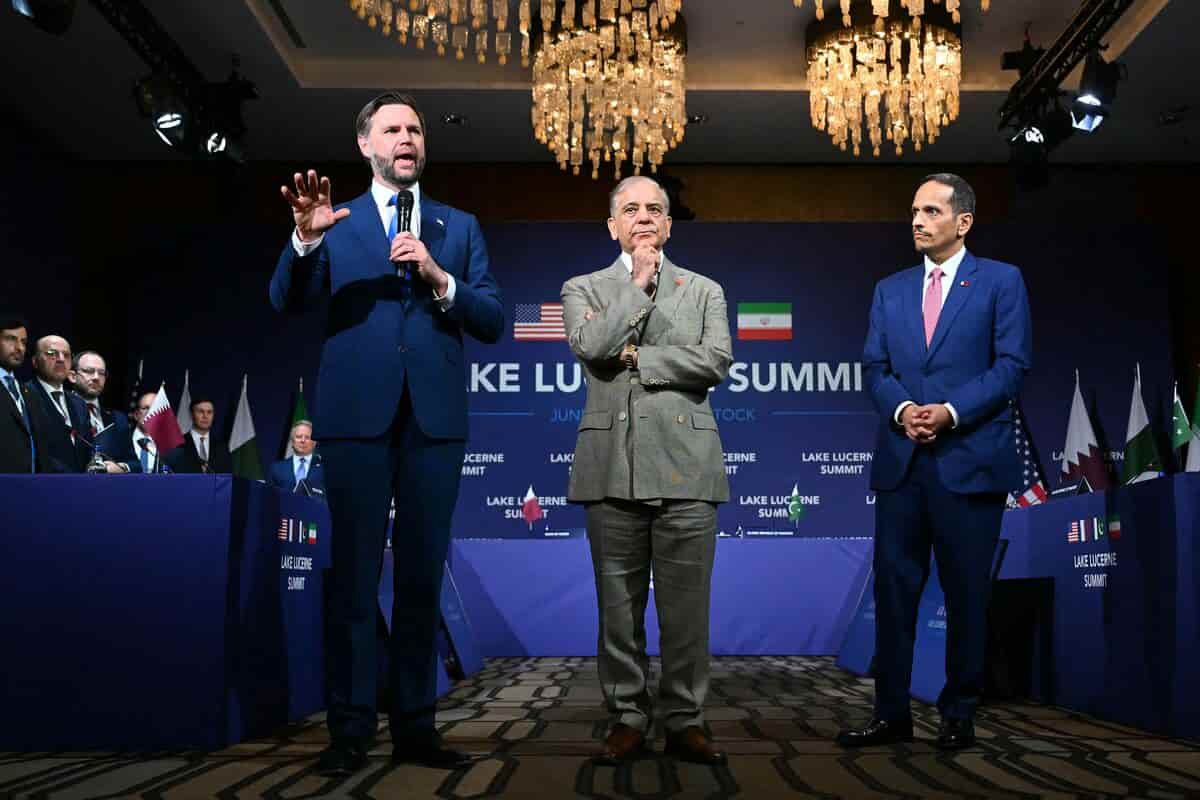
Mediators Qatar and Pakistan announced on Monday that negotiations on a U.S.-Iran peace deal have shown "encouraging progress," with talks set to continue at a technical level. The statement followed a summit in Switzerland involving the U.S., Iran, and the two mediating countries, marking the first high-level meeting between Washington and Tehran since the war began in late February.
A preliminary agreement was signed last week, establishing a 60-day window to finalize a deal. The summit, held at the Bürgenstock resort, resulted in the creation of a "communication line" between the U.S. and Iran to ensure the safe passage of ships through the Strait of Hormuz, a critical global waterway through which 20% of the world's oil and natural gas travels. The memorandum of understanding also stipulates the lifting of blockades and waiving passage fees for the waterway.
Furthermore, a "de-confliction cell" has been established involving the U.S., Iran, and Lebanon to help end the ongoing fighting between Israeli forces and Iran-backed Hezbollah. The U.S. delegation was led by Vice President JD Vance, alongside Special Envoy Steve Witkoff and Jared Kushner, while Iran's delegation included chief negotiator Mohammad Bagher Qalibaf and Foreign Minister Abbas Araghchi. Technical negotiations are scheduled to resume this week, focusing on Iran's nuclear program and U.S. sanctions, with plans for Iran's reconstruction estimated at $300 billion.