Key facts
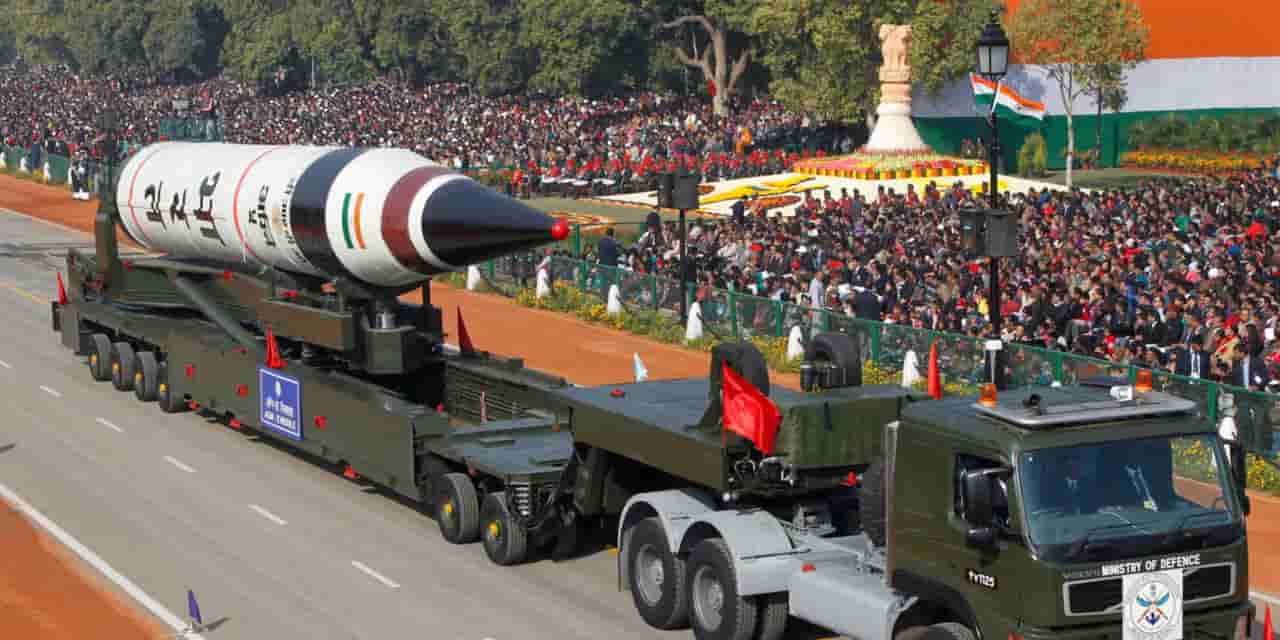
- India possessed 24 Agni-V nuclear-capable intercontinental ballistic missiles with a range of up to 5,000 kilometers as of January.
- India is planning a joint rocket force to control and expand its non-nuclear missiles in response to China's arsenal.
- China's nuclear stockpile increased by at least 100 warheads between 2024 and 2025, reaching 600.
- China's ballistic missiles have ranges up to 2,000 kilometers, while India's current conventional missiles have a reach of about 500 kilometers.
- India is considering using its Agni-5 intercontinental ballistic missile for conventional missions.
India is significantly modernizing its military, with a growing emphasis on developing longer-range weapons to counter China's expanding arsenal, according to recent reports. While India has historically focused on its rivalry with Pakistan, its strategic planning now increasingly factors in China's capabilities.
The Stockholm International Peace Research Institute (SIPRI) reported that India possessed 24 Agni-V nuclear-capable intercontinental ballistic missiles as of January, with a claimed range of up to 5,000 kilometers. This development comes amid concerns that India's ballistic missiles are outmatched by China's.
In response to China's growing arsenal, India has proposed creating a joint rocket force, the Integrated Rocket Force (IRF), to control and expand its non-nuclear missile capabilities. However, the IRF, first proposed in 2021, has faced delays and may still be outgunned by Chinese missiles, which can have ranges up to 2,000 kilometers. India's current conventional missiles, such as the Brahmos and Pralay, have a reach of only about 500 kilometers, sufficient to target areas near the border but not China's economic and industrial hubs.
China's nuclear arsenal has seen a significant increase, with its stockpile growing by at least 100 warheads between 2024 and 2025, reaching an estimated 600. This expansion is noted as being at a greater pace than any other nuclear weapons state. Experts suggest that China's nuclear growth is a deliberate strategy to achieve parity with the United States and Russia, which in turn increases India's vulnerability and compels New Delhi to contend with a dual nuclear challenge from both China and Pakistan.
To address the conventional war-fighting asymmetry with China, the IRF is envisioned as a force dedicated to conventional military action, potentially allowing India to engage the People's Liberation Army along the Line of Actual Control without escalating to the nuclear level. However, the IRF's effectiveness is questioned due to its theoretical status and potential inter-service rivalries. Experts suggest that India could leverage its Agni-5 missile for conventional missions and develop long-range hypersonic weapons, but an integrated organization like the IRF is deemed necessary for effective coordination and deployment of these capabilities.