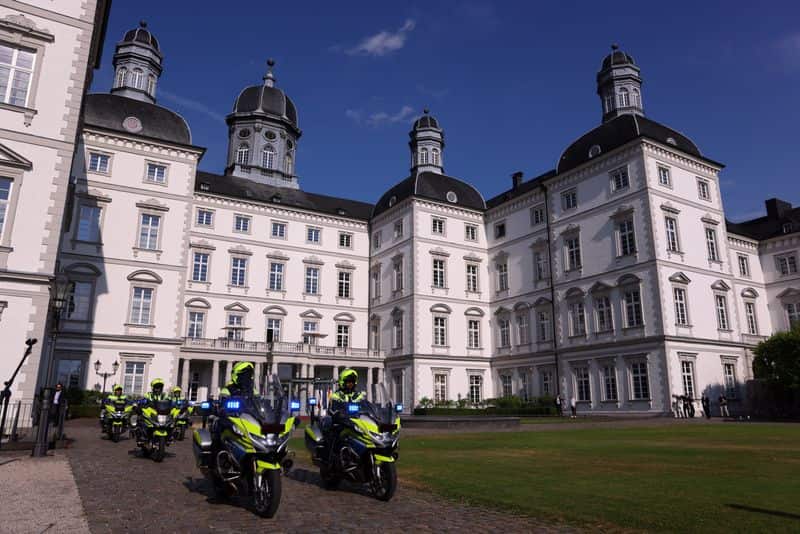
France and Germany are set to discuss deepening their defense cooperation at a joint ministerial retreat, aiming to present a united front despite significant strains in their major armament programs. The meetings, scheduled near Cologne, will cover nuclear deterrence, missile defense, long-range strike capabilities, and space cooperation.
These discussions come weeks after industrial rivalries forced the two nations to scrap the landmark Future Combat Air System (FCAS) fighter jet program, a move that underscores broader challenges in Europe's defense ambitions. Delays to a joint next-generation tank project and setbacks in the multinational Eurodrone program have further highlighted these difficulties.
Following the Franco-German Defence and Security Council and a broader joint ministerial meeting, two joint declarations are anticipated. A French official acknowledged that alignment is not guaranteed but emphasized that Franco-German defense industry cooperation extends beyond the failed FCAS project. A German official indicated that an agreement is expected on how certain elements of the FCAS project will proceed, particularly regarding data links and software for a 'combat cloud'.
President Macron's proposal for 'forward (nuclear) deterrence,' which suggests European allies could participate in French nuclear deterrence exercises and temporarily host French nuclear assets, will also be a key topic. Berlin anticipates agreeing that German troops will participate in a French nuclear exercise in the autumn.
The underlying differences in the Franco-German defense relationship stem from varying views on Europe's dependence on U.S. weapons technology, especially given concerns about President Trump's reliability as a security partner. The Elysee stated that talks would also focus on conventional military capabilities, such as early warning systems and air and missile defense, with France advocating for greater reliance on sovereign European technologies for missile defense.
Space cooperation is another area where recent competition has complicated bilateral ties. France and Germany are expected to reaffirm support for IRIS², the European Union's planned secure satellite communications constellation, even as Berlin pursues its own military satellite constellation project. Paris views IRIS² as crucial for Europe's sovereign communications infrastructure and reducing foreign dependence.