Key facts
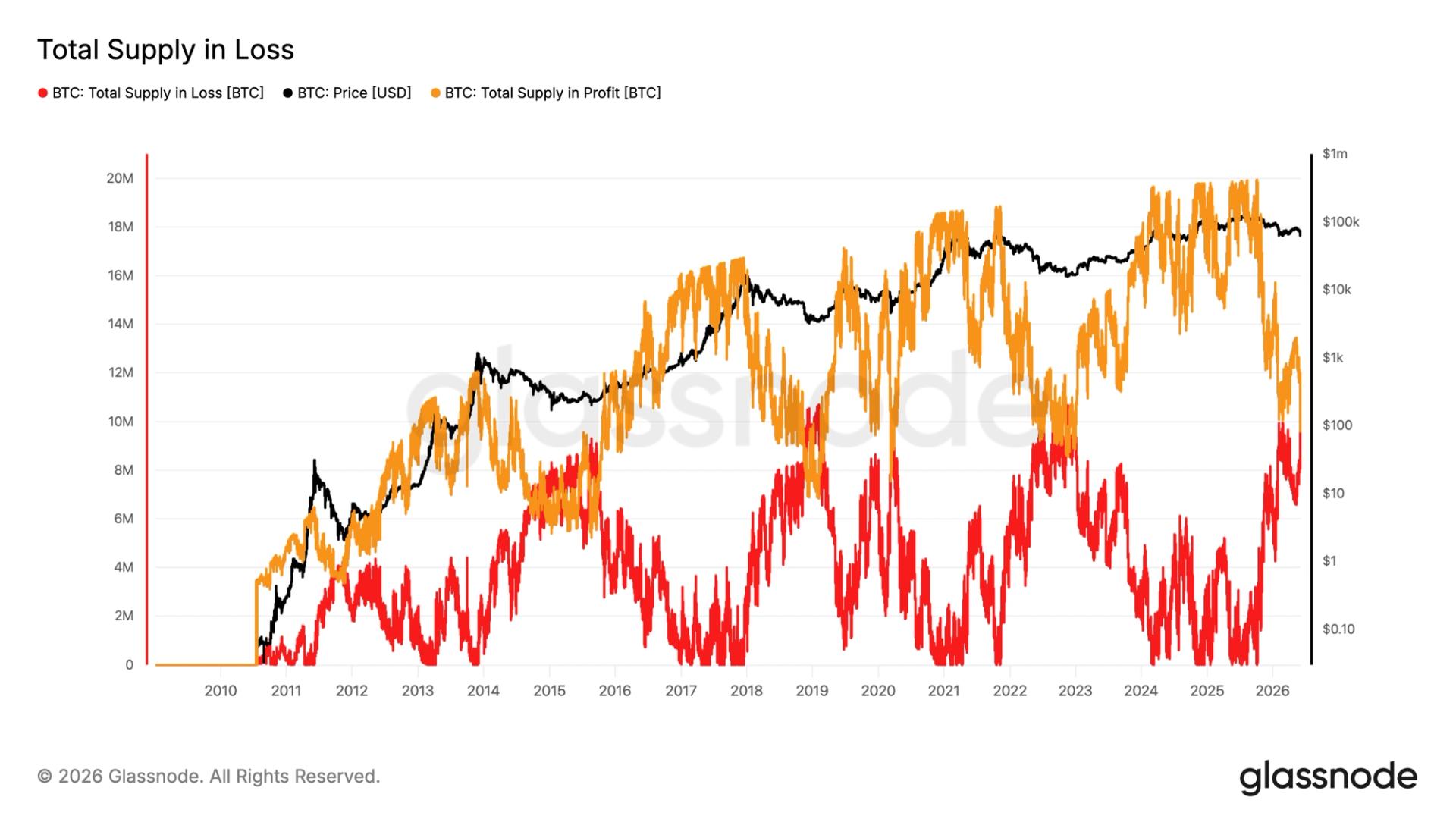
- Bitcoin investors realized a $1.9 billion loss spike during a price drop to $63.6K.
- The Net Realized Profit and Loss (NRPL) metric fell to negative $1.9 billion.
- Over 53,800 BTC were moved onto exchanges from short-term holders in one day, all at a loss.
- Extreme negative NRPL spikes have historically preceded local bottoms for Bitcoin.
- A declining pattern in loss-driven BTC inflows from short-term holders over 48-72 hours is a key signal.
Bitcoin's price decline to $63.6K was accompanied by a significant spike in realized losses, with the Net Realized Profit and Loss (NRPL) metric dropping to negative $1.9 billion. This event, which saw the global crypto market cap shed 5.4% in 24 hours, reflects a large number of investors accepting actual losses rather than paper losses. On-chain data from CryptoQuant indicates that over 53,800 BTC were moved onto exchanges from short-term holders in a single day, with all of these coins being transferred at a loss. Historically, such extreme negative NRPL spikes have served as shakeout phases for short-term investors and preceded local bottom formations. However, CryptoQuant emphasizes that a single-day extreme is a stress marker, not an immediate reversal signal. The key signal to watch for potential bottom formation is a declining pattern in loss-driven BTC inflows from short-term holders over the next 48 to 72 hours, which would indicate shrinking sell pressure and stabilizing price action. Charles Schwab strategist Jim Ferraioli suggests that Bitcoin's production cost for efficient miners, estimated at $60,000, could serve as a cycle bottom. This cost is based on energy consumption at $0.07 per kilowatt-hour with advanced hardware. Less efficient miners face costs around $95,000. The average acquisition cost for U.S. spot ETF holders is near $83,000, and the active investor cost basis is around $78,000, both above current prices. Hedge funds, representing 30% of spot ETP ownership, are market-neutral, providing no directional bid. Ferraioli's analysis also highlights the potential for Bitcoin miners to pivot to high-performance computing (HPC) for AI inference, using Bitcoin mining as a baseload monetization of power during off-peak hours.