All NewsEducationTV
Equities & FundsCrypto & Digital AssetsAI & TechnologyBusiness & CorporateUS Politics & PolicyGeopolitics & Global RiskMacro, Rates & FXCommodities & EnergyEuropean Politics & MarketsAsia-PacificReal Estate & Property
Story archiveAll categories
← All Stories

Poland's Law and Justice party splits ahead of elections

Created at 31 Jul · 6:21 PM1 source↑ Market-relevant
IN SHORT

Poland's conservative Law and Justice (PiS) party has officially split into two factions ahead of next year's parliamentary elections. The division weakens the opposition and potentially benefits Prime Minister Donald Tusk's liberal government.

✉Newsletter

PiQ Daily

Pick your topics. Get only what matters, on your cadence.

Key Numbers

2015-2023years PiS governed Poland
40lawmakers in Morawiecki's new group
5%polling for Morawiecki's party
22%polling for Law and Justice (PiS)
4percentage point drop for PiS in polls
2019year Confederation began facing competition from Confederation of the Polish Cro
2023year Grzegorz Braun incident in parliament
2025year of upcoming parliamentary elections

Who's Involved

Law and Justice (PiS)
Poland's former governing conservative party that has split
Mateusz Morawiecki
Former Prime Minister and leader of PiS's moderate faction
Przemysław Czarnek
Leader of PiS's more radical wing and newly nominated prime ministerial candidate
Donald Tusk
Prime Minister of Poland
Jarosław Flis
Polish political scientist commenting on the split
Confederation
Far-right political party in Poland
Confederation of the Polish Crown
More radical far-right party in Poland
Grzegorz Braun
Leader of the Confederation of the Polish Crown
Anna Wójcik
Political science professor at the University of Warsaw
Leszek Jażdżewski
Polish political scientist and journalist
Andrzej Duda
Ex-President of Poland
Jarosław Kaczyński
Party leader of Law and Justice
Karol Nawrocki
Party's candidate in last year's presidential election
Poland's Law and Justice party splits ahead of elections

↳ Why This Matters

The split within Poland's main conservative party, Law and Justice (PiS), significantly weakens the opposition ahead of crucial parliamentary elections. This internal division, coupled with the rise of far-right movements and shifting public sentiment on issues like Ukraine aid, could alter Poland's political trajectory and its relationship with key allies.

Key facts

  • Poland's Law and Justice (PiS) party has officially split into two factions.
  • The split occurred after months of internal disputes over issues including military aid to Ukraine and domestic policies.
  • Former Prime Minister Mateusz Morawiecki leads a newly formed moderate faction, while Przemysław Czarnek leads the more radical wing of PiS.
  • Morawiecki and 40 lawmakers have formed a new parliamentary group, and Morawiecki has stepped down as leader of the ECR group.
  • The division weakens the opposition ahead of next year's parliamentary elections, potentially benefiting Prime Minister Donald Tusk's government.
  • Far-right parties are gaining support, challenging PiS's historical dominance on the Polish right.

Poland's dominant conservative party, Law and Justice (PiS), has fractured into two distinct factions ahead of the upcoming parliamentary elections, a development that could significantly alter the country's political landscape. The split, confirmed on July 29, follows months of internal discord over a range of issues, including the extent of military aid to Ukraine, economic policies, and the growing influence of the far-right.

The more moderate wing, led by former Prime Minister Mateusz Morawiecki, has formally separated from the party, with Morawiecki and 40 lawmakers establishing a new parliamentary group. This move formalizes a division that had been anticipated for weeks and signals a potential weakening of the opposition's ability to challenge Prime Minister Donald Tusk's liberal coalition. Morawiecki also resigned his leadership of the European Conservatives and Reformists (ECR) group in the European Parliament.

The party's more radical faction is now led by Przemysław Czarnek, who has been nominated as the party's prime ministerial candidate. Political scientists suggest this separation could lead to PiS losing a significant number of seats in the upcoming elections. Polling data indicates Morawiecki's new party is polling around 5%, while PiS has fallen to 22%, a four-percentage-point decrease from previous polls.

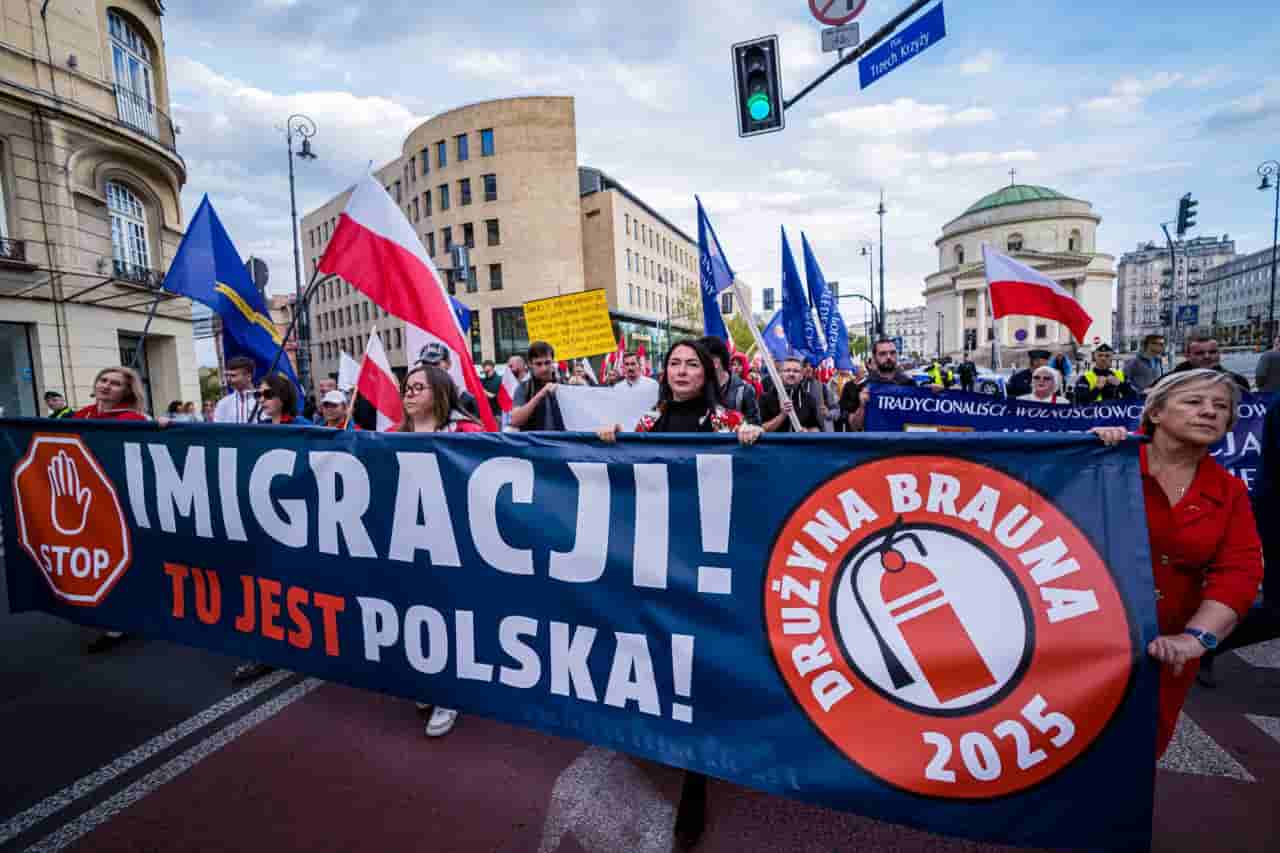
The fragmentation of PiS occurs amidst a broader shift in Poland's right-wing political sphere, with far-right parties like Confederation and the Polish Crown experiencing a surge in support. For the first time in two decades, PiS is no longer the undisputed leader on the Polish right. In an effort to retain voters, PiS has increasingly adopted more right-wing rhetoric and policies, a strategy that has also been observed in other European and U.S. hard-right movements.

Analysts note that the rise of far-right sentiment is mirrored by an increase in anti-Ukrainian sentiment and attacks on Ukrainians within Poland. While PiS and Tusk's Civic Coalition have historically been allies of Kyiv, the party under Czarnek's leadership has reportedly moved in an anti-Ukrainian direction. This contrasts with the previous stance of PiS leaders like Morawiecki, who were prominent faces of support for Ukraine. Younger politicians within PiS are seen as more likely to align with anti-Ukrainian voter sentiment.

Historically, PiS drew support from smaller towns, rural areas, and older voters without university degrees. However, demographic trends are not favorable for the party in the long term. Experts also suggest PiS failed to learn from its 2023 election loss, misinterpreting the victory of its presidential candidate, Karol Nawrocki, as a sign of broader support for PiS rather than a win influenced by the far-right. Furthermore, some of PiS's past government policies, such as an influx of migrants, were unpopular with some right-wing voters. The rise of anti-immigrant rhetoric has been a key driver for parties like Confederation and the Polish Crown. Political scientists predict that with the far-right gaining ground and Morawiecki's faction splitting off, PiS's electoral prospects have diminished, potentially positioning it as one of several parties on the right rather than its historically dominant force.

Frequently asked questions

The party split after months of internal tensions over issues including military aid to Ukraine, domestic policies, and the rise of the far-right.

The moderate faction is led by former Prime Minister Mateusz Morawiecki, while the more radical wing is led by Przemysław Czarnek.

The split weakens the opposition, potentially improving the chances of Prime Minister Donald Tusk's liberal government to secure a second term, and could lead to PiS losing seats.

Yes, parties like Confederation and the Polish Crown are gaining support, challenging PiS's historical dominance on the Polish right.

What Happens Next

01Poland's parliamentary elections are scheduled for next year.
02The new parliamentary group led by Mateusz Morawiecki will operate independently.
03Further shifts in polling numbers for PiS and its rivals are expected.

Get the newsletter.

Pick the topics you actually care about. We'll email when there's news worth your time, on the cadence you choose. Cancel any time from your account.

Cadence

How It Developed

Poland's Law and Justice (PiS) party has split into two factions.
The split follows months of internal tensions over issues including Ukraine aid and domestic policy.
Former Prime Minister Mateusz Morawiecki leads a moderate faction, while Przemysław Czarnek leads the more radical wing.
Morawiecki and 40 lawmakers formed a new parliamentary group, formalizing the separation.
Morawiecki stepped down as leader of the European Conservatives and Reformists (ECR).
The split weakens the opposition's challenge to Prime Minister Donald Tusk's coalition.
Far-right parties like Confederation and the Polish Crown are gaining support, challenging PiS's dominance on the right.
PiS has shifted its rhetoric and policies further right to regain voters.

Sources

T1
Poland's main conservative party splits as debate over Ukraine intensifiesThe Kyiv Independent

Related Stories

EU enlargement capacity strained by rapid accession drive
31 Jul · 8:16 AM
EU-China trade tensions escalate as Beijing retaliates
31 Jul · 9:06 AM
Wildfires highlight French political inaction on climate crisis
31 Jul · 4:11 AM
Italy suspends Schengen with Spain over migrant crisis
30 Jul · 11:06 PM
Iceland to vote on resuming EU membership talks amid deep divisions
31 Jul · 1:11 PM