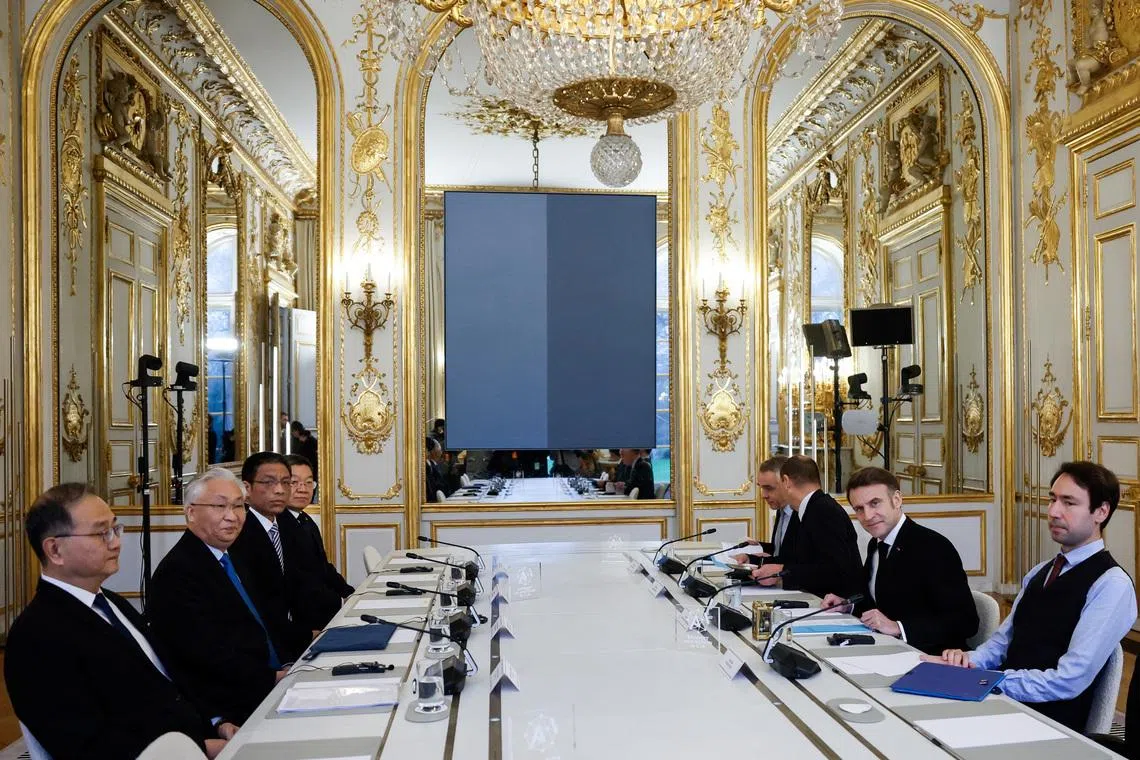
French President Emmanuel Macron is seeking a unified G7 stance against what he describes as a flood of subsidized Chinese exports disrupting global markets. However, even before the summit, it is evident that concrete actions may be difficult to achieve, with China showing little inclination to alter its policies and differing approaches between European nations and the United States.
Macron hosted a video conference on global macroeconomic imbalances, attended by representatives from G7 countries and China. Chinese Vice Premier Zhang Guoqing participated, advocating for "true multilateralism" and prioritizing development and inclusive growth, without directly addressing the concerns over trade imbalances. Following the call, Macron's office characterized it as a success, with participants agreeing to continue discussions at the G20 level with IMF support.
Economists suggest that China is unlikely to fundamentally change its economic model to satisfy G7 demands. While France has historically been a proponent of stronger EU measures against China's trade practices, aiming to reduce a significant trade deficit, the broader European approach and U.S. strategy on China are not fully aligned. U.S. Trade Representative Jamieson Greer indicated that the U.S. would not delay its own actions while awaiting European coordination.
Despite the challenges in forming a united front, Germany's Chancellor Friedrich Merz has shown increased willingness to consider tougher measures against China. The European Commission has also committed to addressing the substantial trade deficit with China, with further discussions planned among EU leaders.
What Happens Next
01G7 leaders will discuss critical minerals, cancer research, and online child protection.
02EU leaders will meet to discuss trade deficits with China.
03Discussions on global imbalances are expected to continue at the G20 level.