Key facts
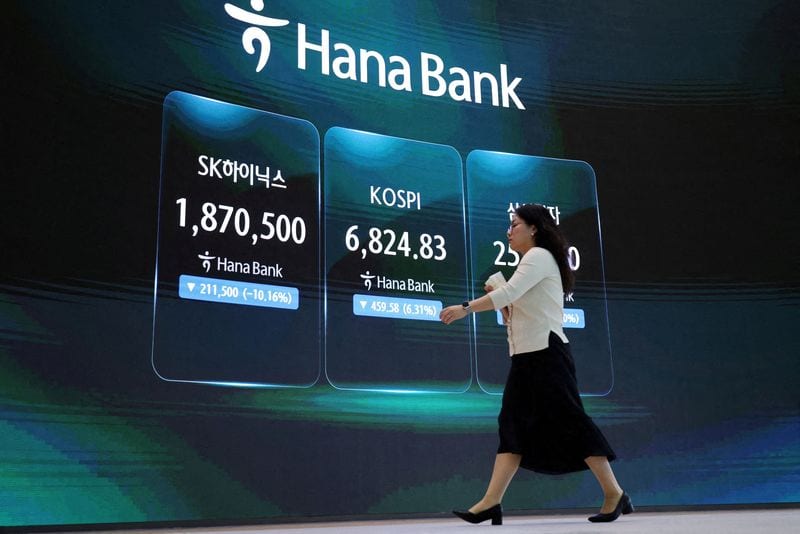
- South Korea's stock market has become highly volatile, driven by leveraged bets on AI chipmakers.
- Over half of the KOSPI's historical circuit breakers have occurred in the last six months.
- Samsung Electronics and SK Hynix, central to the AI boom, now comprise over 50% of the KOSPI.
- Retail investors' margin loans reached a record 38.6 trillion won in June.
- South Korean regulators are implementing measures to curb excessive leverage and volatility.
South Korea's stock market, once a stable indicator of global economic health, is now characterized by extreme volatility driven by speculative, leveraged bets on AI-focused companies, particularly chipmakers Samsung Electronics and SK Hynix. These two firms now constitute over half of the benchmark KOSPI index, leading to a decoupling from traditional economic fundamentals and correlations.
More than half of all circuit breakers, which halt trading when the index drops more than 8%, have been triggered in the past six months alone. This surge in volatility is largely attributed to capital flows from single-stock leveraged exchange-traded funds, which amplify returns but also exacerbate price swings. Retail investors have contributed significantly, with margin loans reaching a record 38.6 trillion won ($23 billion) in June.
Assets in a twice-levered SK Hynix fund have grown more than twentyfold this year, becoming the largest of its kind globally and influencing market movements through rebalancing flows. Regulators are intervening to curb these excesses, with plans to block new leveraged fund launches and triple the minimum cash balance required for trading them to 30 million won ($20,300) from August 5.
Despite the volatility, the AI supercycle has created winners, with SK Hynix recently completing a record $26.5 billion U.S. capital raise. However, the market's detachment from fundamentals raises concerns for institutional investors and global markets, as South Korea's performance is seen as a significant indicator, particularly given the widespread fear of an AI bubble.