Key facts
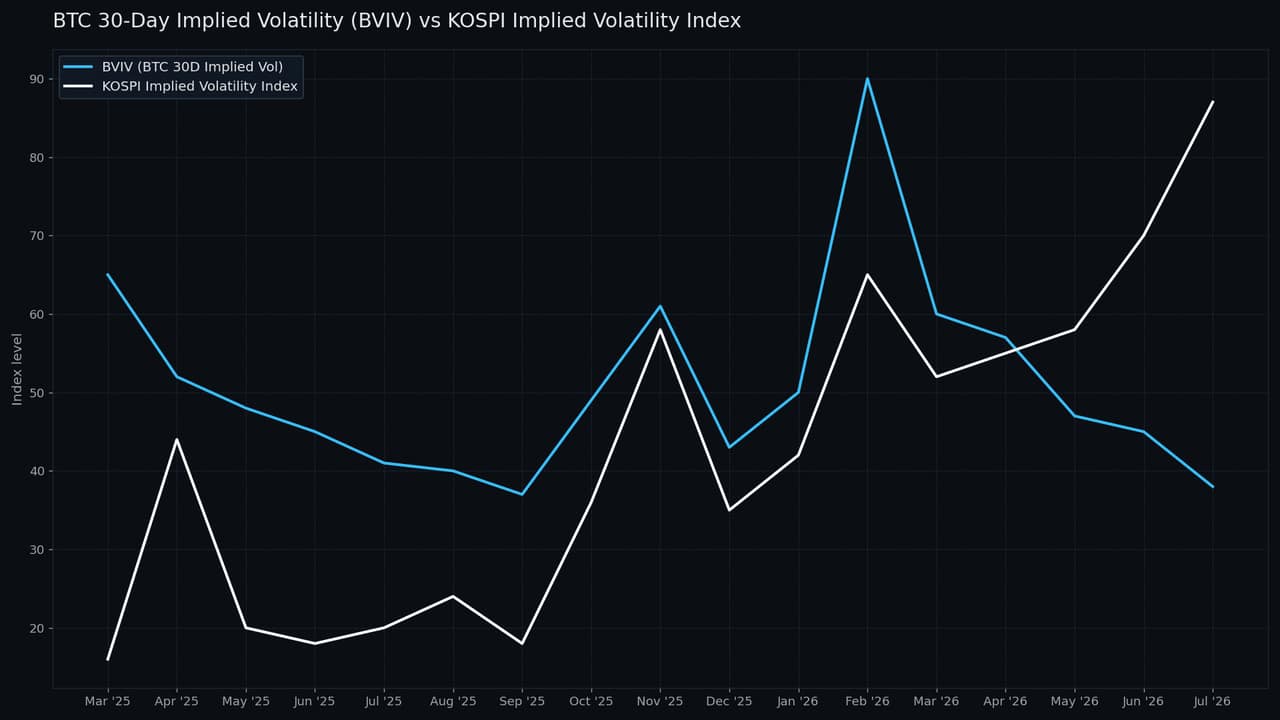
- Bitcoin's 30-day implied volatility is approximately 38%, significantly lower than South Korea's Kospi index at 81%.
- The Kospi index has experienced a sharp decline of nearly 25% in the past four weeks.
- Forced liquidations for Korean retail traders have exceeded $2 trillion in less than three months.
- Bitcoin's volatility is still double that of the S&P 500 index, which has a VIX below 20%.
- Key Bitcoin-holding wallets have not moved substantially into stablecoins despite geopolitical tensions.
- The Clarity Act faces a critical test in Washington D.C. regarding regulatory clarity for the crypto industry.
Bitcoin's implied volatility has fallen below that of South Korea's Kospi index, a significant development driven by the unwinding of the AI frenzy that had previously boosted tech stocks. The Kospi index, a primary beneficiary of the AI boom, has slumped nearly 25% in just four weeks, with its options market indicating at least twice the risk compared to bitcoin.
Options market data shows the Kospi's 30-day implied volatility has surged to an annualized 81%, while bitcoin's equivalent, BVIV, stands at around 38%. This heightened perceived risk in the Kospi is attributed to a surge in margin trading and leveraged ETFs by Korean retail investors, leading to over $2 trillion in forced liquidations in less than three months.
While this marks a notable shift for bitcoin, which is often criticized for its volatility, it still remains twice as risky as the S&P 500 index, whose VIX is below 20%. Analysts are also closely watching regulatory developments in Washington D.C., specifically the Clarity Act, which is facing hurdles related to conflict of interest provisions and Senate challenges.
Despite geopolitical tensions pressuring the broader crypto market, analytics firm Nansen notes that key Bitcoin-holding wallets have not significantly shifted into stablecoins, suggesting a potential resumption of accumulation after short-term leveraged positions are flushed out.