Key facts
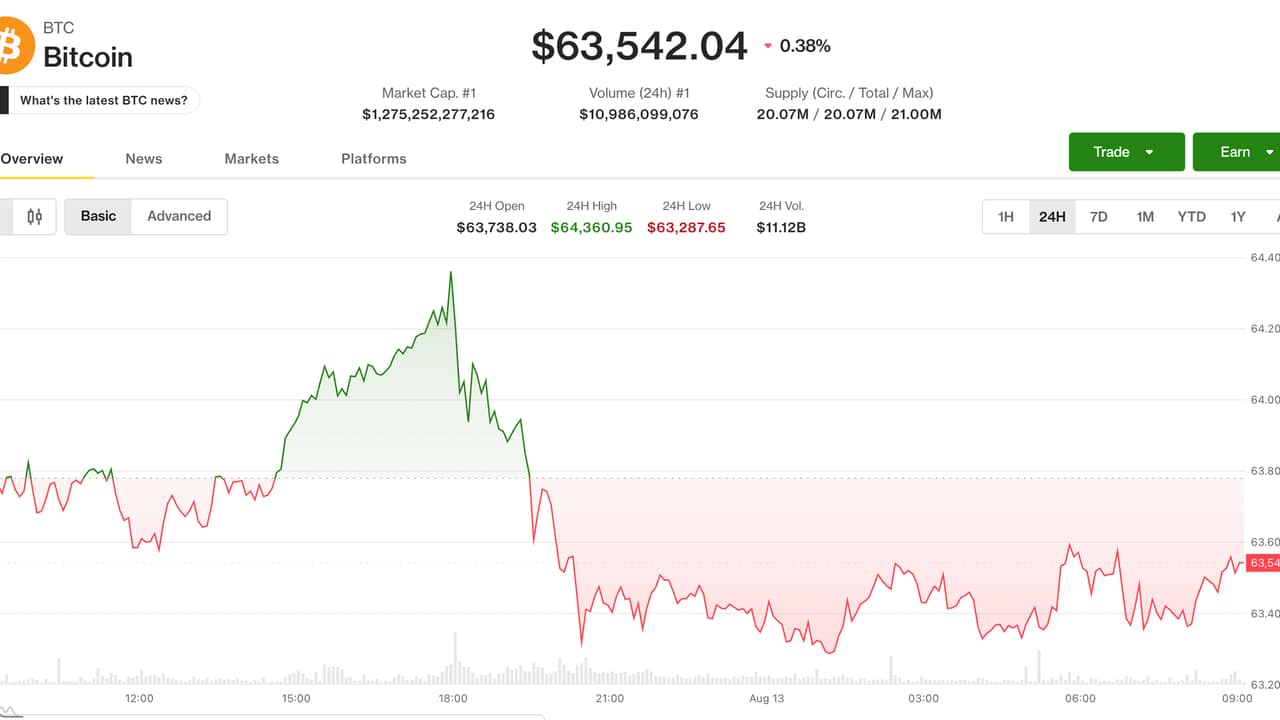
- Bitcoin fell to approximately $63,500, down over half a percent on the day.
- July's headline inflation rose 0.1% monthly and 3.4% annually.
- Core inflation eased to 2.5% annually.
- Futures markets reduced the odds of a September Fed rate hike to 38%.
- Gold rose 1.3%, ether 1%, and bitcoin 0.5% following the inflation data.
- MSCI's Asia Pacific index gained nearly 1%, and Korea's Kospi rallied almost 4%.
Bitcoin experienced a slight decline, trading near $63,500 on Thursday, following the release of U.S. inflation data that met economists' expectations. While the in-line Consumer Price Index (CPI) report eased concerns about immediate Federal Reserve rate hikes, it did not trigger a significant rally in the cryptocurrency market, with most major tokens seeing declines.
July's inflation figures showed a 0.1% monthly increase and a 3.4% annual rise for the headline number, while the core measure, excluding food and energy, rose 0.2% monthly to 2.5% annually. This data led futures markets to trim the probability of a September Fed rate hike to approximately 38% from 46% prior to the release.
Gabe Selby, head of research at CF Benchmarks, noted that bitcoin tends to react most strongly to inflation data when it deviates from expectations, leading to significant gains when inflation undershoots forecasts. An in-line report, he explained, can remove tail risk but requires a genuine surprise to act as a catalyst. He also pointed to moderating shelter and energy costs as factors that might allow the Fed to maintain its current stance.
Global equity markets showed a more positive reaction than cryptocurrencies. MSCI's Asia Pacific index advanced nearly 1%, with contributions from Samsung Electronics and SK Hynix. Korea's Kospi index surged by almost 4%, entering a technical bull market. However, the positive sentiment was not universal, as Cisco's stock fell over 4% after hours due to underwhelming earnings, and Cerebras Systems dropped 17% on declining hardware sales.
In commodities, Brent crude oil eased, snapping a six-day winning streak that had pushed prices to $90 a barrel. This pullback occurred amid reports that Iran was preparing to conduct operations on U.S. soil under a new military doctrine, according to an Islamic Revolutionary Guard Corps adviser.