Key facts
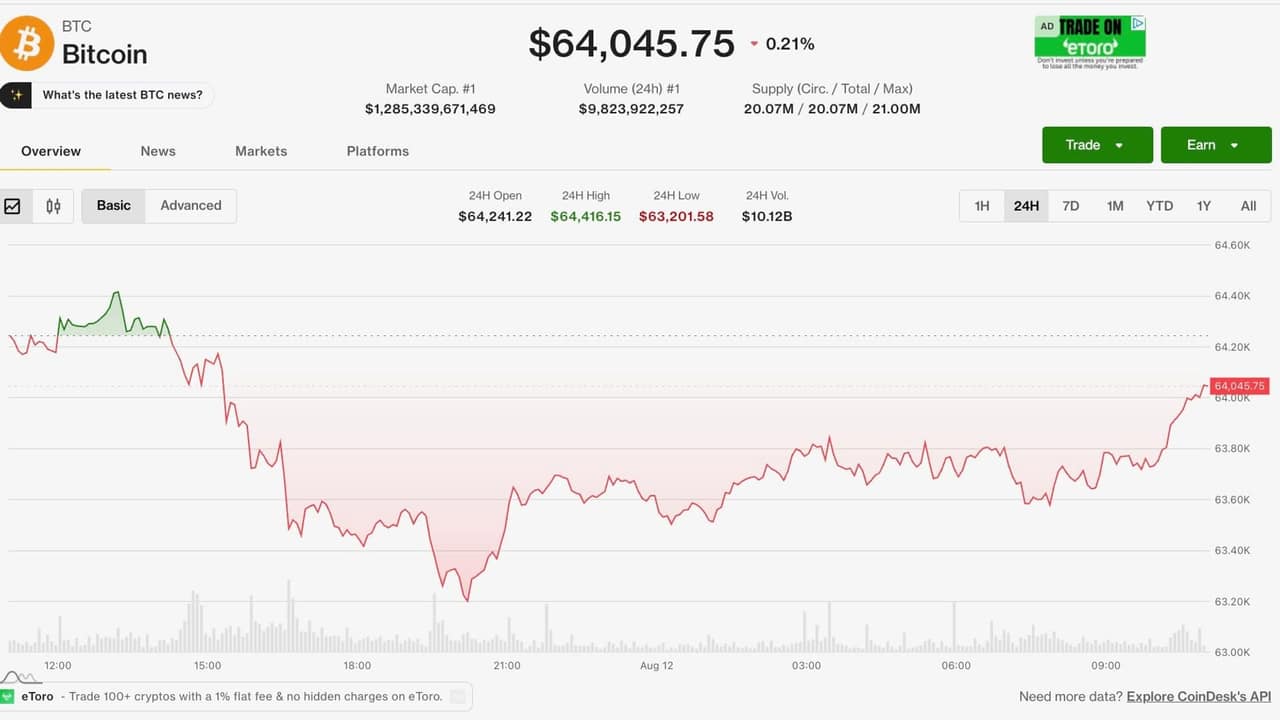
- Bitcoin traded near $63,900 ahead of the U.S. CPI inflation data release.
- Harmony blockchain experienced an exploit resulting in the minting of approximately 4 billion ONE tokens.
- The ONE token dropped significantly, losing up to 40% of its value.
- Brent crude oil prices approached $90 per barrel due to geopolitical tensions in the Bab el-Mandeb Strait.
- Derivatives market data indicated a bearish shift in taker sentiment, with shorts now dominating.
- Implied volatility for Bitcoin remained subdued despite upcoming inflation data.
Bitcoin held near the $64,000 mark on Wednesday as traders awaited key U.S. inflation data, while a significant exploit on the Harmony blockchain sent its native token, ONE, to record lows.
The Harmony network confirmed an exploit early in the Asian session where an attacker minted approximately 4 billion ONE tokens through empty blocks, representing about 26% of the token's circulating supply. Around 2.8 billion of these tokens were quickly funneled to exchanges, causing the ONE token to drop as much as 40%.
Broader crypto markets remained largely steady ahead of the July U.S. Consumer Price Index (CPI) print, scheduled for 12:30 UTC, which is often a key driver for risk assets. Bitcoin saw a modest gain of 0.23% since midnight UTC, trading around $63,979, with the total crypto market capitalization holding at $2.19 trillion. The Fear and Greed index stood at 38.
Geopolitical factors also influenced market sentiment, with Brent crude oil prices nearing $90 a barrel following fresh Houthi attacks on shipping in the Bab el-Mandeb Strait and a U.S. strike on a vessel in the Gulf of Oman. These events renewed supply concerns, potentially complicating the inflation outlook.
Analysis of derivatives markets indicated a bearish shift in taker sentiment, with the long-short ratio flipping to favor shorts at 51.36%, a reversal from earlier in the week. Avalanche (AVAX) showed signs of aggressive shorting, with open interest climbing 6% as its price declined. Dogecoin (DOGE) futures open interest has also increased significantly, suggesting a potential for near-term volatility.
Selling pressure appeared to dominate the broader altcoin market, as most of the 25 largest cryptocurrencies exhibited negative 24-hour cumulative volume deltas. Exceptions included Chainlink (LINK), Cronos (CRO), and Tron (TRX).
Implied volatility for Bitcoin remained depressed, with its 30-day index (BVIV) falling to 37.5%, signaling that options traders may be underpricing the event risk associated with the upcoming U.S. CPI release. Despite this, options traders were seen positioning for volatility, with the $70,000 call contract remaining active and a growing preference for BTC strangles, a strategy designed to profit from sharp moves in either direction.
In other token news, CRV was the week's standout performer, up approximately 35% amid an impending emissions reduction. Uniswap (UNI) experienced a notable decline of over 10% in 24 hours without a clear catalyst, while Monero (XMR) recovered its recent losses. AI-themed tokens such as NEAR, FET, and TAO also saw modest gains.