Key facts
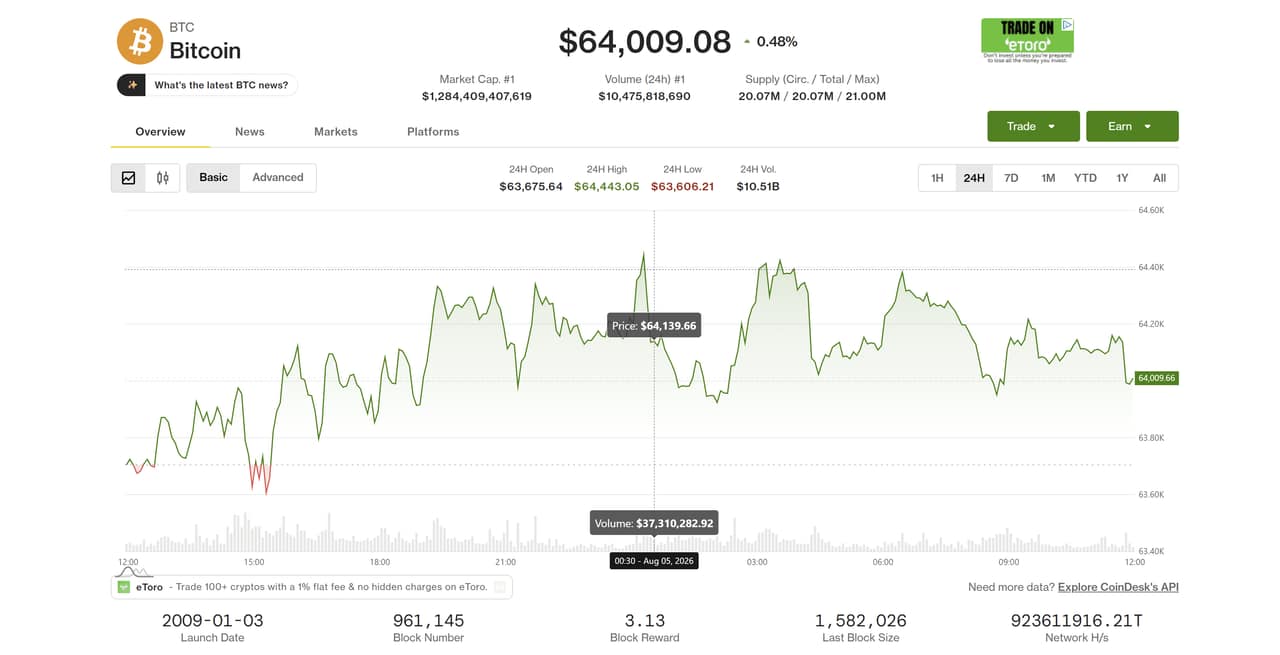
- Bitcoin traded near $64,000, largely flat as global equities hit record highs.
- Global stock indexes were boosted by AI optimism and easing energy concerns.
- Tether's market capitalization has decreased by $4 billion over 60 days, signaling capital outflow from crypto.
- U.S. spot bitcoin ETFs experienced $5.4 billion in net outflows in the first half of the year.
- Derivatives data indicate subdued activity in bitcoin and ether futures, with some aggressive positioning in select altcoins.
Bitcoin remained largely flat around $64,000 on August 5, 2026, even as global equity markets surged to record highs. This divergence highlights weakness specific to the cryptocurrency market, which is seeing capital rotation into AI-linked assets.
Global stock indexes, including the MSCI All Country World Index, its Asia Pacific benchmark, and Australian shares, reached new peaks. The S&P 500 and Dow Jones Industrial Average also closed at all-time highs. This rally was fueled by optimism surrounding artificial intelligence and progress in reopening the Strait of Hormuz, which contributed to lower oil prices.
In contrast, the broader CoinDesk 20 index was unchanged, with an equal number of components rising and falling. U.S. spot bitcoin ETFs experienced significant net outflows totaling $5.4 billion in the first half of the year, indicating a cooling of institutional and retail interest in crypto as an investment.
Derivatives data show subdued activity in bitcoin and ether futures, though there is aggressive positioning in select altcoins. Tokens like PUMP, ZEC, and BNB saw open interest gains, while SHIB, HBAR, and LTC experienced declines. XLM, however, showed a notably negative annualized perpetual funding rate of -23%, suggesting bearish sentiment.
A significant contraction in Tether's market value, shrinking by $4 billion over 60 days, is being interpreted as a sign of capital leaving the crypto ecosystem. CryptoQuant noted that such deep contractions in USDT supply have historically preceded bitcoin recoveries, but a sustained bottom would require USDT supply to begin increasing again.