Key facts
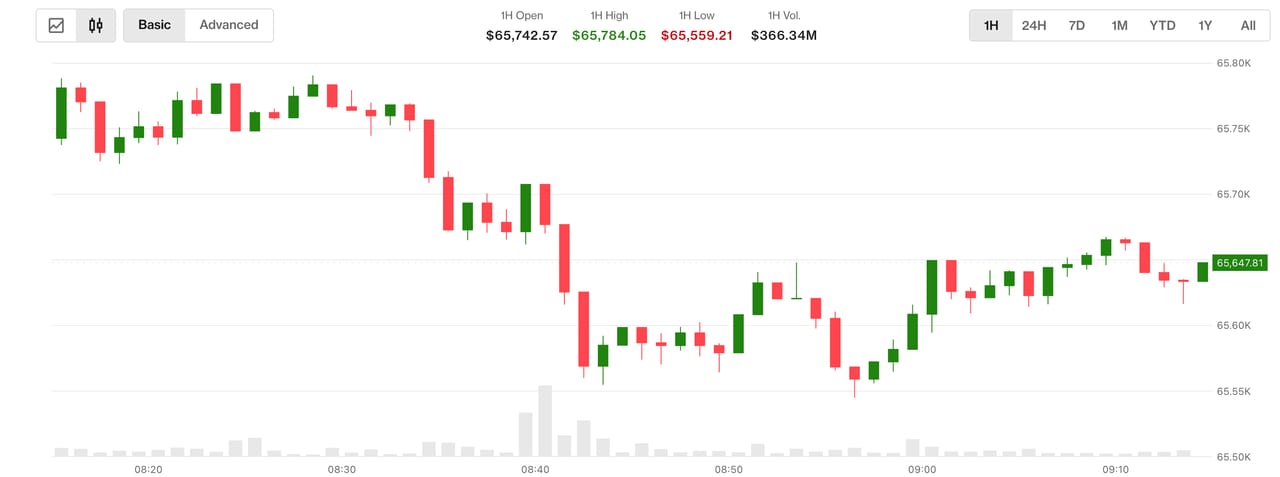
- Bitcoin's price fell to approximately $65,500.
- Rising oil prices and higher Treasury yields are pressuring cryptocurrencies.
- U.S. military strikes linked to Iran have dampened market sentiment.
- Key Senate Democrats expressed concerns about the Digital Asset Market Clarity Act.
- Odds for the Clarity Act's passage have decreased to 38%.
Bitcoin experienced a decline, trading near $65,500, as rising oil prices and higher Treasury yields exerted pressure on risk assets. The cryptocurrency's weakness extended to other major tokens like ether, solana, and XRP.
Futures for West Texas Intermediate crude oil reached $88.60 per barrel, the highest level since June 11, signaling a potential inflationary impulse that could complicate central bank efforts to lower interest rates. Bond markets reflected this sentiment, with the U.S. two-year Treasury yield climbing to 4.31% and the 10-year yield reaching 4.66%, making fixed-income securities more attractive.
Adding to market caution, reports indicated that the U.S. military deployed a B-1 bomber for strikes linked to Iran’s Islamic Revolutionary Guard Corps, suggesting an escalation of operations. This geopolitical tension further dampened sentiment.
Regulatory uncertainty persisted as key Senate Democrats criticized the latest draft of the Digital Asset Market Clarity Act, stating it falls short on ethics and other critical provisions. In response, betting odds on the decentralized platform Polymarket for the Act's passage dropped from 46% to 38%. Senate Republicans had released the updated draft, which included an ethics provision agreed upon by the White House and President Donald Trump, with Senator Bernie Moreno describing it as "the most powerful ethics language in U.S. history."