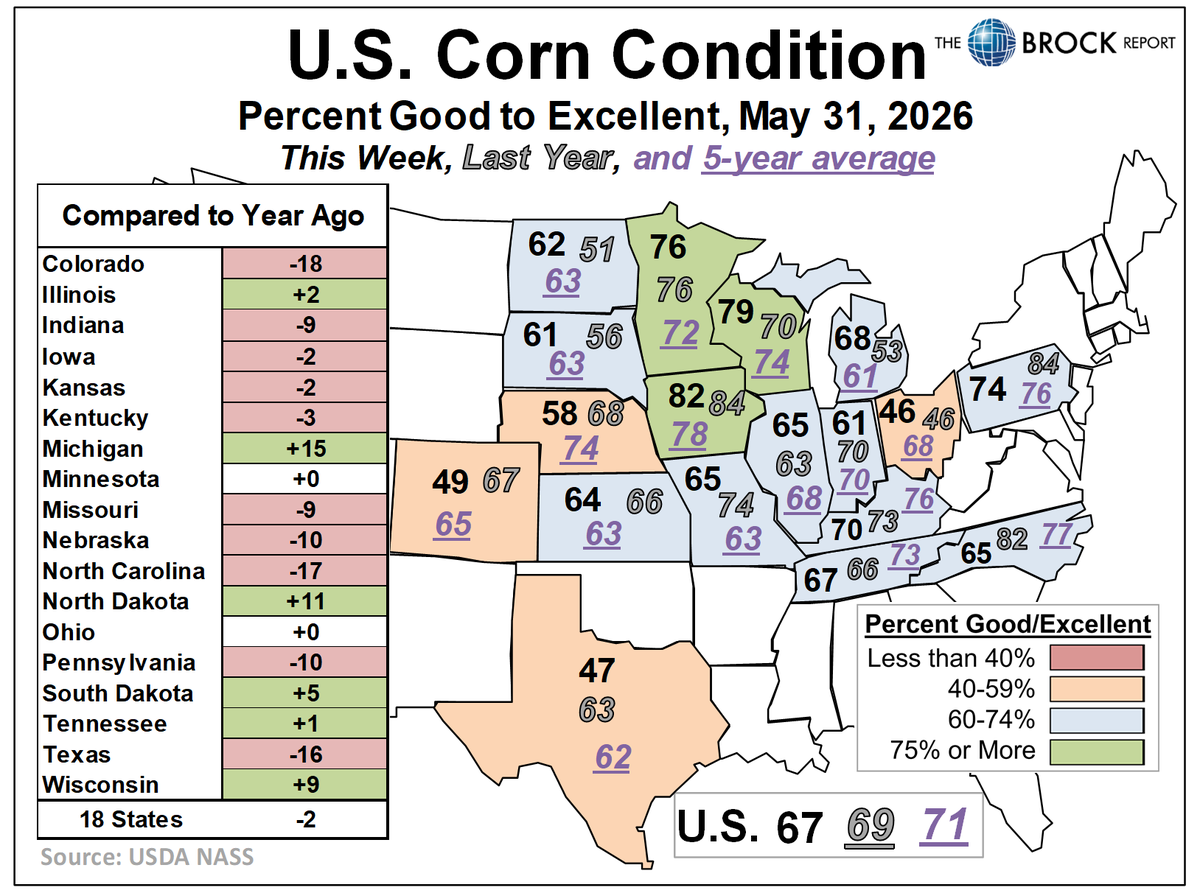
Key facts
- US corn crop is rated 67% good/excellent.
- US soybean crop is rated 66% good/excellent.
- Soybean emergence is at its fastest pace since 2001.
- US corn and soybean crop ratings missed market expectations.
- Soybean crush margins reached a record $4.07 per bushel.
- Brazil's second corn crop harvest has begun, with 2.4% harvested.
- Saskatchewan farmers have completed 80% of seeding.
- Stripe rust has been confirmed in Michigan wheat fields.
- Farm operation bankruptcy filings in the US are below 2015-19 levels.
- The cultivated area for cotton in Mato Grosso for the 25/26 harvest is estimated at 1.38 million ha.
The initial U.S. crop condition ratings for corn and soybeans have been released, with corn at 67% good/excellent and soybeans at 66% good/excellent. While soybean emergence is at its fastest pace since 2001, these figures fell below market expectations, causing corn futures to drop 3.5 cents to $4.40'4 and soybean futures to slide 15.5 cents to $11.65'2. Soybean crush margins have reached a record $4.07 per bushel, a significant increase from $1.46 at the start of the year, which is expected to boost processor demand.
In other agricultural developments, Brazil's second corn crop harvest has commenced rapidly, with 2.4% of the area already harvested, ahead of last year's pace, facilitated by clear weather in Mato Grosso. However, falling prices and high freight costs are impacting Brazilian farmer profit margins. Saskatchewan farmers have completed 80% of seeding, though this remains behind the five-year average, with wet conditions in some northeastern and east-central regions causing delays. Rainfall in the western prairies offers mixed conditions, with some dry areas receiving welcome rain while others experience excessive wetness hindering crop completion. Stripe rust, a fungal disease, has been confirmed in Michigan wheat fields, prompting growers to scout and consider fungicide applications. Midwest drought conditions are expected to ease with anticipated rain later in the week, though abnormally dry conditions persist in the Upper Midwest.
Globally, the cultivated area for cotton in Mato Grosso, Brazil, for the 25/26 harvest is estimated at 1.38 million hectares, an 11.11% decrease from the previous period. The Philippines has booked 190,000 metric tons of soy meal. Geopolitical tensions, including potential U.S. tariffs on Brazil and a Strait of Hormuz closure impacting oil prices, have also influenced agricultural futures, though corn prices are now reportedly decoupling from oil and focusing on weather forecasts. A new Economic Bulletin highlights the resilience of the U.S. farm sector, noting that farm operation bankruptcy filings are below 2015-19 levels and the sector's debt-to-asset ratio is near historical norms. New calculators are also available to assist growers with input strategies and fertilizer blends.