Key facts
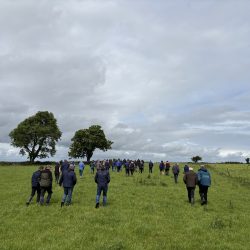
- Ger and Enda Armstrong in Galway won the Galway Sustainable Pasture Progress Award for 2025.
- Their herd's EBI increased to €161.
- They achieved a milk price 5c/L higher than average.
- Incorporating white clover can reduce chemical nitrogen fertiliser inputs by 150-180 kg N/ha.
- Optimal white clover content in swards is 20-30%.
- Over 80% of Irish soils require lime application.
- Every €1 invested in lime can yield €6-€10 in increased grass production.
- Agriland and Teagasc DairyBeef 500 are publishing a series on calf management.
- Average milk protein is 3.53% but can drop over 0.2% in summer.
- Dairy farmers Katie and Phil Gleeson use AgNav to manage environmental performance.
- They switched to 100% protected urea and use low-emission slurry spreading.
- Ashbourne Meats hosted a Limousin cull cow carcase competition with €2,000 in prizes.
Irish farmers are increasingly adopting sustainable practices to enhance farm productivity and profitability, particularly in response to rising input costs and environmental concerns. A key focus is on improving grassland management, with initiatives like the Galway Sustainable Pasture Progress Award recognizing farms that boost milk solids and achieve higher milk prices through breeding and grass focus. Ger and Enda Armstrong in Galway, for instance, have improved their herd's EBI to €161 and secured a milk price 5c/L above average by prioritizing breeding for solids and optimizing pasture utilization.
Reducing reliance on chemical nitrogen fertilizer is another significant trend, with the incorporation of white clover into grassland swards identified as a highly effective method. CAFRE adviser Nigel Gould suggests that a 20-30% content of white clover can reduce nitrogen inputs by 150-180 kg N/ha and potentially increase livestock live weight gain, offering a natural alternative to costly chemical fertilizers. Similarly, applying lime to correct sub-optimal soil pH is crucial for maximizing nutrient availability, with Teagasc research indicating that over 80% of Irish soils require lime, and each €1 invested can yield €6-€10 in increased grass production.
Efforts are also underway to improve livestock performance and efficiency. Agriland and the Teagasc DairyBeef 500 team are providing guidance on calf management to enhance performance during weaning and the first grazing season, aiming for strong daily gains and efficient grass conversion. Maintaining milk protein levels, which can drop significantly during summer months due to suboptimal grassland management, is also a priority. Farmers are advised to manage grass allocations and quality to prevent energy deficits that affect milk protein, body condition, and fertility.
Environmental performance is being actively managed through technological solutions. Dairy farmers Katie and Phil Gleeson are utilizing AgNav to measure and manage emissions, transitioning to 100% protected urea, employing low-emission slurry spreading, and incorporating clover into re-seeds. This platform also tracks improvements in herd genetics and overall carbon footprint. Updates from ABP Monitor Farms in Sligo highlight strong cattle performance, particularly in dairy-beef yearling cattle, with improved grass growth and successful first-cut silage. The suckler herd has also finished calving with minimal issues.
Fertilizer management for second-cut silage is also being addressed, with Teagasc advising on nutrient replacement for phosphorus and potassium removed by heavy first cuts. Recommendations include applying 50-100kg N/ha for second-cut silage, prioritizing slurry application before chemical fertilizer. In a separate event, Ashbourne Meats hosted a Limousin cull cow carcase competition, awarding €2,000 in prizes to winners from Co. Cork and Co. Mayo, recognizing quality in both Limousin-cross and pedigree Limousin cow classes.