Key facts
- China approved eight new nuclear power reactors across four projects.
- The investment for these projects is estimated at $24 billion.
- The reactors will be built in Zhejiang, Guangdong, Liaoning, and Shandong provinces.
- Domestically developed third-generation nuclear technologies will be used.
- China aims to increase its nuclear capacity to 110 million kilowatts by 2030 and 200 GW by 2035.
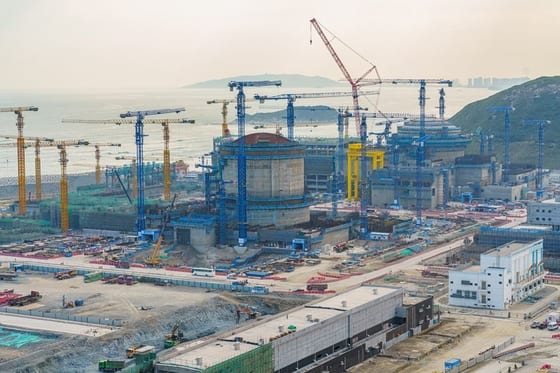
China's State Council has approved the construction of eight new nuclear power reactors across four projects in Zhejiang, Guangdong, Liaoning, and Shandong provinces, representing an estimated investment of 160 billion yuan ($24 billion). These projects will utilize domestically developed third-generation nuclear technologies, including Hualong One and CAP1000 designs.
The approvals, made during a meeting presided over by Premier Li Qiang, are part of China's broader strategy to scale up nuclear power capacity for enhanced energy security and long-term decarbonization. China aims to reach 110 million kilowatts of nuclear capacity by 2030 and 200 GW by 2035, contributing to its goal of carbon neutrality by 2060.
China's nuclear sector emphasizes technological self-reliance, with the Hualong One being a key third-generation reactor design. The country has also commissioned the world's first commercial fourth-generation high-temperature gas-cooled reactor and is developing small modular reactors (SMRs) like the Linglong One. This rapid expansion contrasts with slower development in many Western countries, attributed to China's centralized planning, industrial capability, and consistent policy support.
China General Nuclear (CGN) received approval for Phase II of its Taishan plant and Phase III of its Fangchenggang plant, both using Hualong One technology. China National Nuclear Corporation (CNNC) received approval for Phase III of its Sanmen plant, also using Hualong One. These new units are expected to begin operations between 2030 and 2031.