Key facts
- General Motors installed about 50 new robot arms at its Factory Zero plant in Detroit.
- 1,300 autoworkers remain indefinitely laid off from the Factory Zero plant.
General Motors has installed approximately 50 new robot arms at its Detroit electric vehicle factory, Factory Zero, while 1,300 workers remain indefinitely laid off. The United Auto Workers union expressed anger over the automation push, suggesting the company could recall workers instead of deploying new robots.
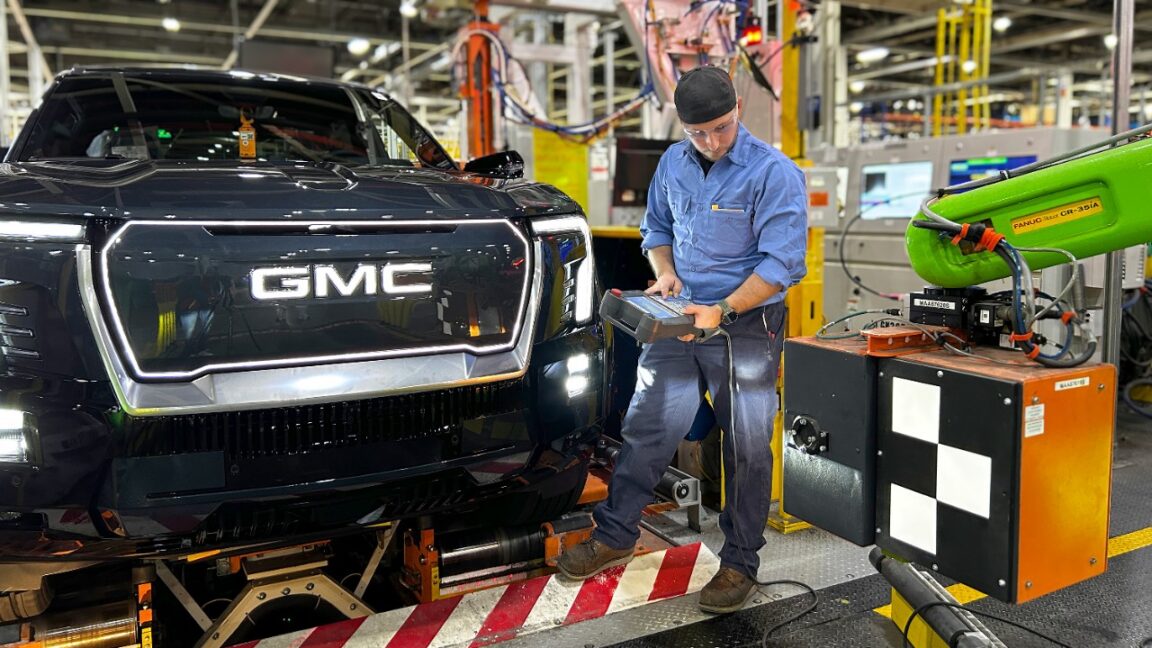
The increasing deployment of robots in automotive manufacturing, even as human workers face layoffs, highlights a growing tension between automation, corporate profit motives, and labor employment. This trend raises significant questions about the future of work in the auto industry and the potential impact on wages and job security.
General Motors has installed approximately 50 new robot arms at its flagship electric vehicle factory, Factory Zero, in Detroit, Michigan. This automation push comes as 1,300 autoworkers remain indefinitely laid off, a situation that has drawn sharp criticism from the United Auto Workers (UAW) union.
The robots, supplied by Japanese robotics firm FANUC, are intended to assist in attaching components to vehicles on the assembly line. UAW leaders, however, view this development with anger, arguing that the company could recall its laid-off members instead of deploying new automation. James Cotton, president of UAW Local 22, stated that over 1,000 union members are still "laid off indefinitely."
These recent layoffs follow permanent job cuts affecting another 1,200 workers at the same Factory Zero plant in October 2025. Many automakers, including Stellantis NV and Ford Motor Company, are increasingly automating their U.S. operations with robots. Hyundai Motor Company, for instance, plans to deploy Boston Dynamics humanoid robots in its Georgia EV facility by 2028.
Union members like Andrew Bergman, a Local 22 member who was laid off, expressed concerns that corporate leaders prioritize profits over human workers. Bergman noted that while technological advancements can improve safety and working conditions, they are being used by "bosses and billionaires" to increase profits and lay off employees. This sentiment was echoed at the UAW Constitutional Convention, where UAW president Shawn Fain warned about the threat of robotics and mass automation to employment and wages amid rising wealth inequality.