Key facts
- Global state subsidies have reached $108 billion, an average of 1.3% of company revenues across 15 key industrial sectors.
- Chinese firms receive state support equivalent to roughly 2.5% of their revenue, compared to 0.3% for firms in peer nations.
- China's semiconductor sector has received government subsidies equivalent to approximately 10% of revenues.
- Chinese integrated circuit exports increased by 83.7% year-over-year to $103.5 billion in the first four months of 2026.
- China controls over 80% of the global photovoltaic supply chain due to state subsidies.
- The U.S. has imposed tariffs of up to 100% on various Chinese renewable energy products and EVs.
- The European Commission has imposed countervailing duties of up to 35.3% on Chinese BEVs.
Governments worldwide are increasingly implementing state subsidies to bolster domestic industries and secure supply chains, a trend significantly amplified by recent global disruptions. A report by the Organisation for Economic Co-operation and Development (OECD) indicates that global state subsidies have surged to $108 billion, representing an average of 1.3% of company revenues across 15 key industrial sectors, the highest level since the 2008-2009 financial crisis.
China has been particularly aggressive in its use of state subsidies, providing its domestic firms in strategic sectors with three to eight times more support than their competitors in OECD countries over the past two decades. This substantial government aid, including direct grants and below-market loans, is estimated to have driven approximately 60% of Chinese companies' global market share gains. Chinese firms receive subsidies equivalent to about 2.5% of their revenue, starkly contrasting with the 0.3% received by firms in peer nations like Japan and South Korea.
The disparity is most pronounced in the semiconductor and solar panel industries. China's semiconductor sector has benefited from subsidies equivalent to roughly 10% of revenues in recent years, compared to 2% globally. State-backed investment vehicles are channeling significant funds into advanced chip manufacturing, leading to an 83.7% surge in China's integrated circuit exports to $103.5 billion in the first four months of 2026. Chinese memory firms are emerging as major global players, and domestic development of advanced lithography machines signals a push for manufacturing self-sufficiency.
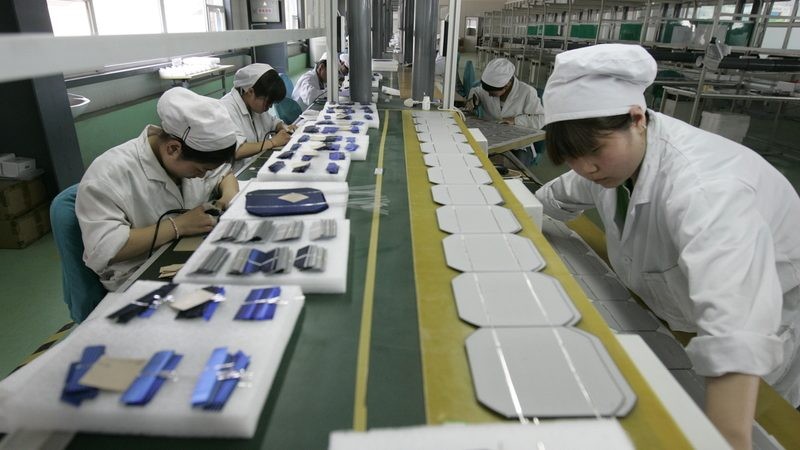
Similarly, China's solar panel manufacturing sector, heavily funded by the state, controls over 80% of the global photovoltaic supply chain. This has led to massive overcapacity, with China's annual solar manufacturing capacity nearly double global installation demand, driving down average selling prices by 90% over the last decade and a half. While this has made solar energy more affordable globally, it has also caused financial distress for Chinese solar companies.
In response to China's state-backed industrial expansion, Western economies are increasingly employing tariffs and other measures. The U.S. has imposed significant levies on Chinese renewable energy products and EVs, including 50% tariffs on solar cells and 100% on EVs. The European Commission has also implemented countervailing duties of up to 35.3% on Chinese BEVs. These actions reflect a shift away from a purely market-driven approach towards a more competitive, state-supported model to counter China's strategy of building national champions with patient capital and long-term planning.