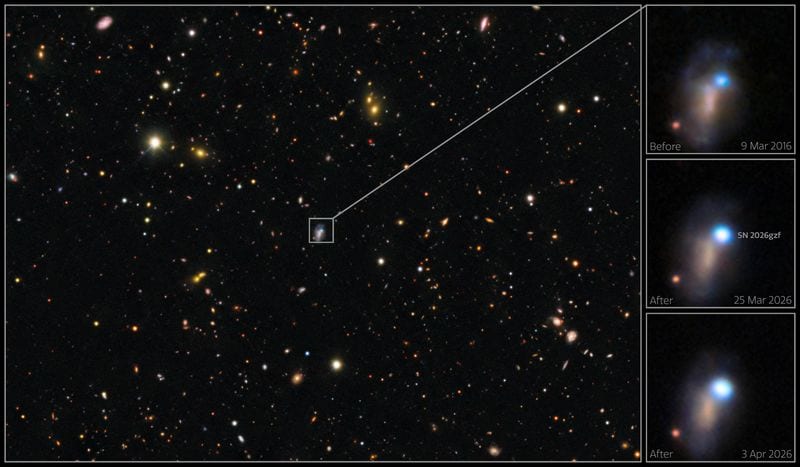
Key facts
- Astronomers observed the full process of a massive star's death.
- The observation included a shock breakout and a subsequent supernova.
- This event provides new insights into how stars die.
- The observation serves as a laboratory for studying extreme physics.
- This is the first time the complete process of a massive star's death has been observed.
For the first time, astronomers have observed the complete process of a massive star's explosive death. This rare event, encompassing both the initial shock breakout and the subsequent supernova, offers unprecedented insights into the diverse ways stars can die. The observation serves as a unique laboratory for studying extreme physics, providing valuable data on stellar evolution. Scientists are particularly interested in how this event compares to other observed stellar deaths, as the mechanisms can vary significantly. This comprehensive view allows for a deeper understanding of the complex processes that lead to a star's final moments and the subsequent release of energy and matter into the cosmos. The data gathered is expected to refine existing models of stellar death and potentially reveal new phenomena.