Key facts
- Wearable devices are evolving into AI-powered health intelligence systems capable of disease prediction and performance optimization.
- Key innovations include continuous 24/7 biometric monitoring, non-invasive glucose tracking, and AI health assistants.
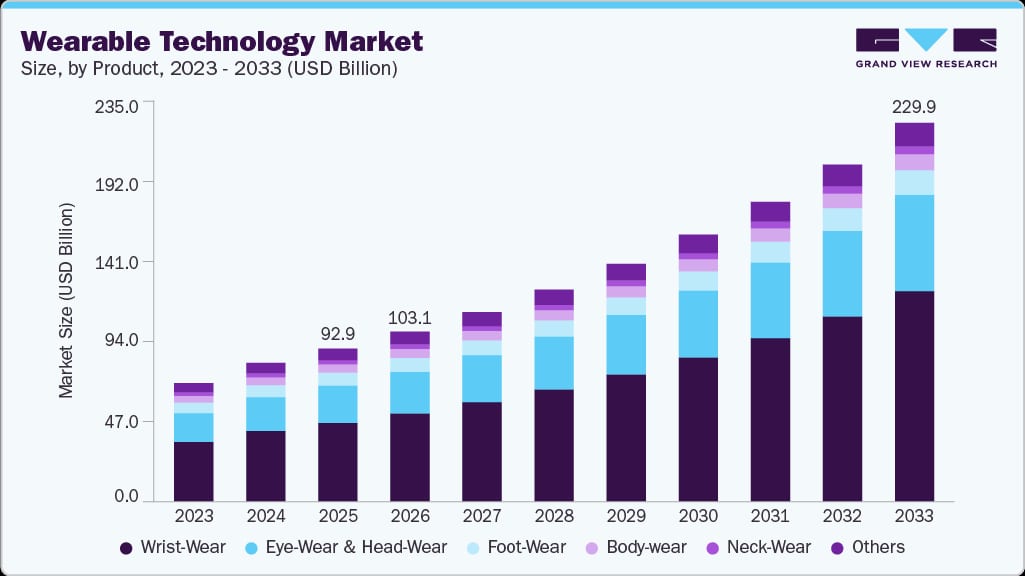
- The market is projected to grow from $92.90 billion in 2025 to $229.97 billion by 2033.
- Sleep and recovery tracking have become more important to users than step counting.
- Wearables are increasingly integrated with telemedicine for remote patient monitoring and clinical decision support.
Wearable technology is rapidly evolving beyond simple fitness tracking to become sophisticated, AI-driven health intelligence platforms. Major companies like Google, Apple, and Samsung, alongside startups such as Oura, are competing to integrate data from these devices into the broader healthcare system. This shift signifies a move towards continuous, 24/7 biometric monitoring, with capabilities extending to disease prediction, performance optimization, and personalized health coaching.
Recent studies highlight the impact of wearable data. A large study in The Lancet (2026) involving over 135,000 adults found that even modest increases in daily movement and reductions in sedentary time were associated with significant decreases in mortality. Another study in Sleep journal demonstrated that improved sleep consistency, tracked by wrist-worn devices like the WHOOP Strap, correlated with enhanced cardiorespiratory fitness and parasympathetic activity.
Innovations in 2026 include advanced features such as continuous heart rate variability (HRV) tracking, blood oxygen monitoring, skin temperature and stress detection, and AI-powered sleep stage analysis. The focus is shifting from merely collecting data to providing real-time health insights, including anomaly detection and early warnings, forming the basis of preventive healthcare. The development of non-invasive glucose monitoring is a highly anticipated breakthrough that could unlock real-time nutrition feedback and metabolic optimization.
AI is playing a crucial role, powering personalized health assistants that offer actionable recommendations for sleep, recovery, workout optimization, and stress management. The market is also seeing innovation in form factors, with a growing trend of users combining smart rings and smartwatches to leverage the strengths of each. Furthermore, wearables are increasingly achieving medical-grade capabilities, such as ECG monitoring and irregular heart rhythm detection, blurring the lines between consumer gadgets and clinical health tools, which opens doors for remote patient monitoring and insurance integration.
The wearable market is experiencing substantial growth, with a projected market size of $229.97 billion by 2033, up from $92.90 billion in 2025, at a CAGR of 12.1%. Within this landscape, sleep and recovery tracking have become more important to users than traditional step counting. The science supporting HRV-guided training is also maturing, with multiple trials showing performance gains. Generative AI is further enhancing fitness apps, with early evidence suggesting personalized AI coaching can increase physical activity adherence by 20-30%.