HomeAll NewsEducationTV
Equities & FundsCrypto & Digital AssetsAI & TechnologyBusiness & CorporateUS Politics & PolicyGeopolitics & Global RiskMacro, Rates & FXCommodities & EnergyEuropean Politics & MarketsAsia-PacificReal Estate & Property
Story archiveAll categories
← All Stories

US launches advanced robotic satellite for geosynchronous orbit servicing

Created at 24 Jul · 3:26 PM1 source↑ Market-relevant
IN SHORT

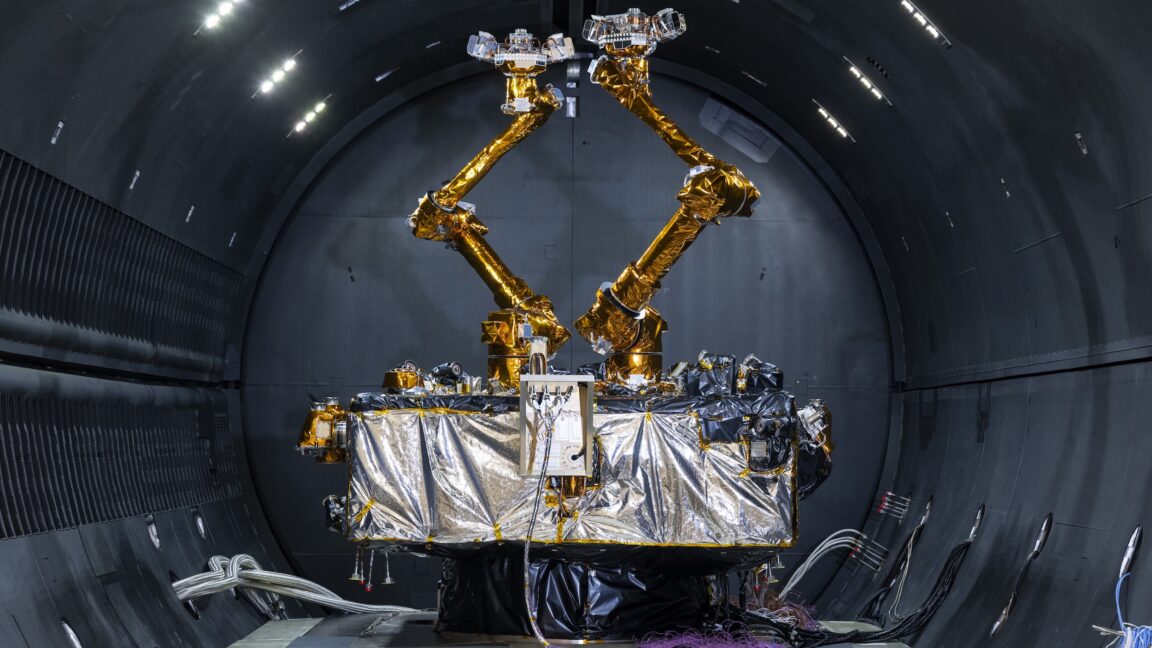
Northrop Grumman's Mission Robotic Vehicle (MRV), equipped with advanced robotics developed by DARPA, has launched on a SpaceX Falcon 9 rocket. The satellite is designed for decade-long missions to service, inspect, upgrade, or repair other spacecraft in geosynchronous orbit.

✉Newsletter

PiQ Daily

Pick your topics. Get only what matters, on your cadence.

Key Numbers

22,000 milesTarget orbit altitude for MRV
36,000 kilometersTarget orbit altitude for MRV
2016Year China launched a satellite with a robotic arm
2021Year China launched Shijian-21 (SJ-21)
January 2025Planned launch of China's SJ-25 refueling mission
$420 millionDARPA investment in the satellite's robotics payload
2007Year DARPA's Orbital Express mission launched
2015Year DARPA formally established the RSGS program
2002Year DARPA first funded NRL's space robotics work

Who's Involved

Northrop Grumman
Builder and owner of the Mission Robotic Vehicle
SpaceX
Launched the MRV on a Falcon 9 rocket
DARPA
Developed the satellite's robotics payload
US Navy
Naval Research Laboratory developed the RSGS robotics payload
Gen. Stephen Whiting
Head of US Space Command, testified on China's capabilities
Bernard Kelm
Acting director of NRL’s Naval Center for Space Technology
SpaceForce
Has a contract for refueling demonstrations
Astroscale
Company contracted for refueling demonstrations
US launches advanced robotic satellite for geosynchronous orbit servicing

↳ Why This Matters

This launch signifies a major leap in space technology, enabling on-orbit servicing and potentially extending the lifespan and capabilities of valuable satellites, which has implications for both civilian and military operations in space.

Key facts

  • Northrop Grumman's Mission Robotic Vehicle (MRV) has launched into orbit.
  • The MRV is equipped with advanced robotic arms developed by DARPA.
  • The mission aims to provide satellite servicing, inspection, and upgrades in geosynchronous orbit.
  • The program is a public-private partnership between Northrop Grumman and DARPA.
  • The RSGS robotics payload has been in development for over 20 years.

The Mission Robotic Vehicle (MRV), a highly advanced satellite designed for servicing other spacecraft, has been launched into geosynchronous orbit aboard a SpaceX Falcon 9 rocket. Developed through a public-private partnership between Northrop Grumman and the Defense Advanced Research Projects Agency (DARPA), the MRV is intended to open new possibilities in satellite servicing over a planned decade-long mission.

The MRV, along with three Mission Extension Pods (MEPs), was deployed into orbit from Florida. It will take approximately a year for these payloads to reach their operational orbit, over 22,000 miles above the equator, where they will match Earth's rotation.

This mission marks a significant advancement in US capabilities, with the MRV being described as the most sophisticated orbiting servicer known. It builds upon Northrop Grumman's previous Mission Extension Vehicles (MEVs) but incorporates DARPA-funded robotic arms, allowing it to perform a wider range of tasks beyond just extending the life of a single satellite. These tasks include inspection, servicing, upgrading, or repairing satellites that were not originally designed for such interventions.

The development of the MRV's robotics payload, known as the Robotic Servicing of Geosynchronous Satellites (RSGS) program, has been a multi-decade effort involving DARPA and the US Naval Research Laboratory. This initiative aims to shift the paradigm from a 'launch-and-abandon' approach to on-orbit intervention capabilities, which have clear military applications, according to US Space Command officials who have expressed concerns about China's developing counterspace capabilities.

While China has previously launched satellites with robotic arms for debris mitigation and demonstrated refueling capabilities, the MRV represents the US's most advanced response in this domain. The Space Force also has separate plans to demonstrate refueling in geosynchronous orbit with a company called Astroscale.

Frequently asked questions

The MRV is an advanced satellite designed for servicing other spacecraft in geosynchronous orbit, equipped with robotic arms for inspection, repair, and upgrades.

The robotics payload was developed by DARPA through its Robotic Servicing of Geosynchronous Satellites (RSGS) program, in partnership with the US Naval Research Laboratory.

Geosynchronous orbit is over 22,000 miles above the equator, where satellites orbit at the same speed as Earth's rotation, appearing stationary from the ground. This orbit is used for communications, weather, and military satellites.

Unlike earlier missions that focused on extending the life of a single satellite, the MRV's robotic arms allow it to service multiple satellites and perform a wider range of tasks, including inspection and upgrades.

What Happens Next

01The MRV and MEPs will maneuver into their operational geosynchronous orbit.
02The MRV will begin its decade-long mission of satellite servicing.
03Astroscale is scheduled to demonstrate refueling in geosynchronous orbit next year.

Get the newsletter.

Pick the topics you actually care about. We'll email when there's news worth your time, on the cadence you choose. Cancel any time from your account.

Cadence
CME Headlines
  • Is AI Making Inflation Better or Worse?
    22 Jul · 3:26 PM

How It Developed

Northrop Grumman's Mission Robotic Vehicle (MRV) launched on a SpaceX Falcon 9 rocket.
The MRV, accompanied by three Mission Extension Pods, entered orbit from Cape Canaveral.
The MRV and pods will maneuver into a circular orbit over 22,000 miles above the equator.
The MRV is described as the most advanced servicing satellite known, building on previous commercial servicing missions.
China has previously launched satellites with robotic arms for tasks like debris mitigation and refueling demonstrations.
The MRV's robotics payload was developed by DARPA through the Robotic Servicing of Geosynchronous Satellites (RSGS) program.
The RSGS program traces its origins back to a DARPA study in 2002.
The MRV can inspect, service, upgrade, or repair satellites not originally designed for servicing.
Sponsored

London Quick Take - 22 July - UK inflation softens, oil rises and chips rally ahead of Alphabet, Tesla earnings

SAXO

Sources

T1
This is the world’s most advanced robotic servicing satellite—that we know aboutvar abtest_2164372 = new ABTest(2164372, 'impression');Ars Technica

Related Stories

SpaceX Starship launch set for Friday; India's Vikram-1 reaches orbit
24 Jul · 2:41 PM
Elon Musk thanks chipmakers for memory allocation amid AI boom
23 Jul · 7:36 PM
China's CiDi aims for overseas sales of autonomous mining machines this year
24 Jul · 10:10 AM
Japan rocket for small satellites completes burn test ahead of launch
23 Jul · 5:50 PM
AI guardrails hinder cybersecurity researchers, experts say
24 Jul · 1:11 AM