HomeAll NewsEducationTV
Equities & FundsCrypto & Digital AssetsAI & TechnologyBusiness & CorporateUS Politics & PolicyGeopolitics & Global RiskMacro, Rates & FXCommodities & EnergyEuropean Politics & MarketsAsia-PacificReal Estate & Property
Story archiveAll categories
← All Stories

SpaceX eyes tower catch for next Starship after successful ocean splashdown

Created at 25 Jul · 5:51 PM1 source↑ Market-relevant
IN SHORT

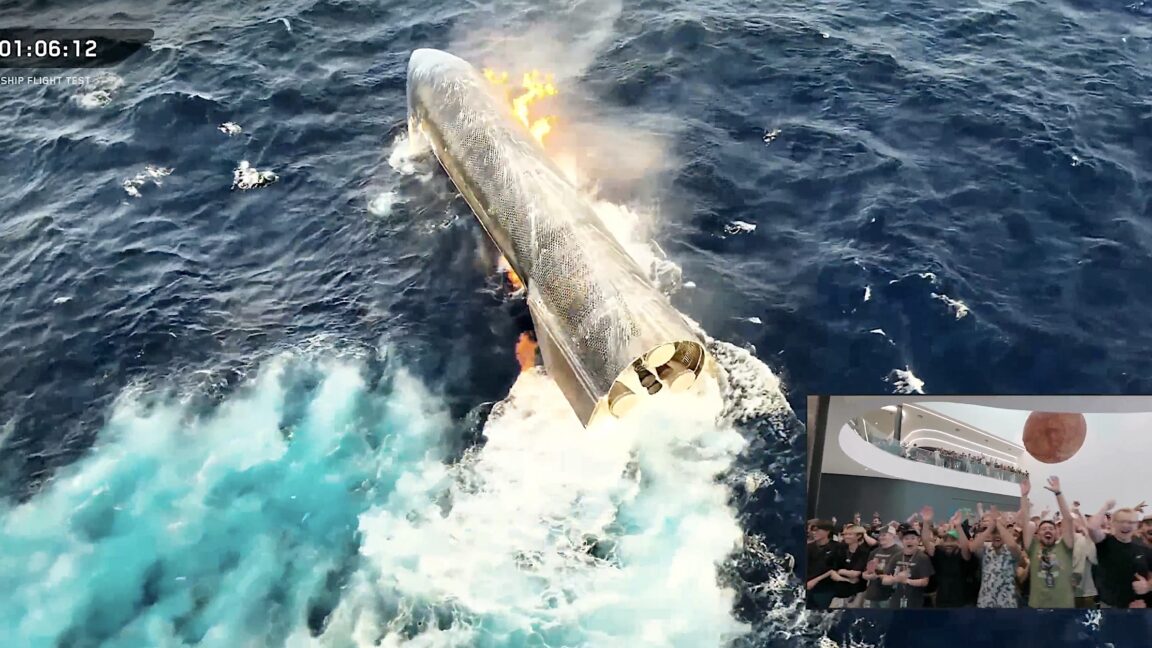
SpaceX successfully splashed down its 13th Starship test flight in the Indian Ocean, gathering crucial heat shield data. The company now plans to attempt catching the vehicle with its launch tower on the next flight.

✉Newsletter

PiQ Daily

Pick your topics. Get only what matters, on your cadence.

Key Numbers

13thStarship test flight number
2,600°FMaximum heat shield temperature
1,430°CMaximum heat shield temperature
18,000+Ceramic tiles on Starship's heat shield
1Intact Starship water landing
20Starlink V3 satellites deployed
408-foot-tallRocket height
124-meterRocket height
33Raptor engines on Super Heavy booster
6Raptor engines on Starship

Who's Involved

SpaceX
Company that conducted the Starship test flight
Elon Musk
Founder and CEO of SpaceX
Dan Huot
SpaceX communications manager
SpaceX eyes tower catch for next Starship after successful ocean splashdown

↳ Why This Matters

This successful test flight and the planned tower catch attempt are critical steps toward SpaceX's goal of making Starship a fully reusable launch system, which is essential for its ambitious plans for lunar missions, Mars colonization, and rapid satellite deployment.

Key facts

  • SpaceX's 13th Starship test flight successfully splashed down in the Indian Ocean.
  • The intact splashdown provides crucial data on the performance of Starship's heat shield.
  • SpaceX founder Elon Musk stated the company will attempt to catch Starship with its launch tower on the next flight, provided no issues are found.
  • The Super Heavy booster experienced a hard splashdown due to issues with its landing burn engines.
  • Starship deployed 20 Starlink V3 satellites during its hour-long flight.

SpaceX successfully completed its 13th full-scale Starship test flight, achieving an intact splashdown in the Indian Ocean. This marks a significant milestone for the program, particularly for gathering data on the performance and durability of Starship's heat shield, which endured temperatures up to 2,600°F (1,430°C).

Encouraged by the flight's success, SpaceX founder and CEO Elon Musk indicated that the company plans to attempt a more ambitious maneuver on the next launch: catching the Starship vehicle with its launch tower as it returns from a longer-range trajectory, potentially into low-Earth orbit. This would involve mechanical arms on the tower attempting to capture the ship during a hover, a feat SpaceX has already accomplished with its larger Super Heavy booster, albeit at a lower speed.

"Unless we discover problems after mission data review, SpaceX will attempt to catch the ship with the tower on next flight," Musk stated on X. The intact splashdown is considered a "dream scenario" for engineers seeking data on the heat shield's resilience, which is critical for SpaceX's goal of rapid reusability and multiple flights per day. The vehicle's design allows for reuse, but not after exposure to saltwater, opening the possibility for towing the rocket back to shore for detailed inspection.

During the hour-long flight, Starship also deployed 20 upgraded Starlink V3 satellites, the first of their kind designed for SpaceX's larger rocket. These satellites, larger and heavier than previous versions, are intended for higher throughput and power. They were designed to burn up upon atmospheric reentry, but SpaceX was able to establish contact and download telemetry before their demise.

The Super Heavy booster, which separated from Starship after launch, experienced issues during its landing burn. While it successfully completed the high-thrust portion of its boostback burn, some engines failed to restart for the landing burn, resulting in a hard splashdown in the Gulf of Mexico. This contrasts with previous successful booster recoveries and re-flights using the Starship Version 2 design.

Frequently asked questions

The primary goals were to achieve an intact splashdown in the Indian Ocean and gather data on the heat shield's performance during reentry.

It allows engineers to inspect the heat shield and other components for detailed analysis, crucial for refining the design for reusability.

SpaceX intends to attempt catching the Starship vehicle with its launch tower on the next flight, a maneuver previously achieved with the Super Heavy booster.

The booster experienced engine issues during its landing burn, resulting in a hard splashdown in the Gulf of Mexico.

What Happens Next

01SpaceX will review mission data to identify any issues.
02SpaceX will attempt to catch Starship with its launch tower on the next flight.

Get the newsletter.

Pick the topics you actually care about. We'll email when there's news worth your time, on the cadence you choose. Cancel any time from your account.

Cadence
CME Headlines
  • Is AI Making Inflation Better or Worse?
    22 Jul · 3:26 PM

How It Developed

SpaceX launched its 13th Starship test flight from South Texas.
Starship completed an intact splashdown in the Indian Ocean.
Engineers are inspecting Starship's heat shield for data on its performance.
SpaceX plans to attempt catching Starship with its launch tower on the next flight.
The Super Heavy booster experienced a hard splashdown due to engine issues.
Starship deployed 20 Starlink V3 satellites during the flight.
Sponsored

London Quick Take - 22 July - UK inflation softens, oil rises and chips rally ahead of Alphabet, Tesla earnings

SAXO

Sources

T1
SpaceX eyes tower catch for next Starship after auspicious end to 13th flightvar abtest_2164756 = new ABTest(2164756, 'impression');Ars Technica

Related Stories

SpaceX Starship test flight deploys new Starlinks but booster fails
24 Jul · 11:26 PM
SpaceX Starship completes successful test flight and splashdown
25 Jul · 1:06 AM
Canadian legislator reads AI prompt instruction aloud in speech
24 Jul · 9:31 PM
Museums use data to enhance visitor experience
25 Jul · 11:12 AM
South Korean, global tech firms agree on $950B AI cooperation projects
25 Jul · 4:41 AM