Key facts
- Skyroot Aerospace's Vikram-1 rocket successfully reached orbit on its inaugural launch.
- The rocket lifted off from Sriharikota Island, India, and achieved an orbit approximately 280 miles high.
- The launch was delayed by over half an hour due to a last-minute technical issue.
- The Vikram-1 rocket is designed to carry payloads of up to 770 pounds (350 kilograms) into low-Earth orbit.
- Skyroot Aerospace has raised approximately $160 million, valuing the company at $1.1 billion.
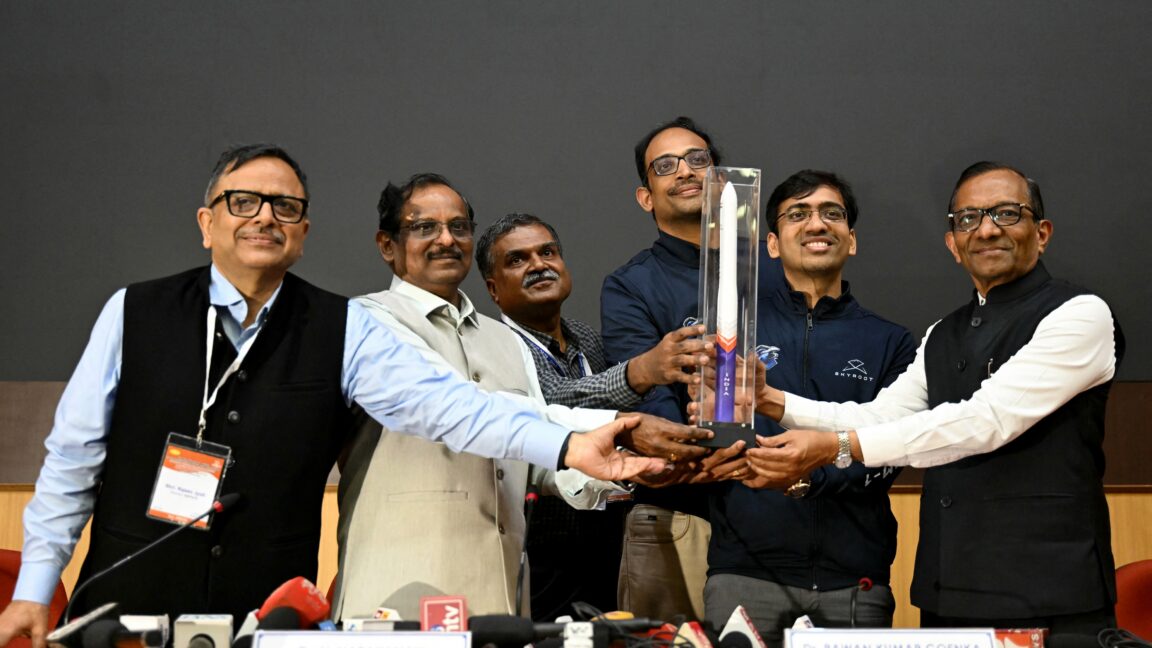
Skyroot Aerospace's Vikram-1 rocket successfully reached orbit on its debut launch Saturday, marking a significant achievement for India's private space sector. The rocket lifted off from the Satish Dhawan Space Center on Sriharikota Island, overcoming a last-minute technical issue that caused a brief delay.
The Vikram-1, standing about 72 feet tall, is capable of placing payloads of up to 770 pounds into low-Earth orbit. The launch sequence involved three solid-fueled stages followed by a liquid-fueled fourth stage that accelerated the rocket to orbital velocity. Live camera views from the rocket showed each phase of the ascent.
While the separation of the third and fourth stages appeared unusual, with the spent third stage remaining close to the fourth, the fourth stage successfully fired its engine to achieve an orbit approximately 280 miles high at a 60-degree inclination. US military tracking data confirmed the rocket's orbital insertion.
Pawan Kumar Chandana, Skyroot's co-founder and CEO, described the launch as a "grand success" and one of the biggest milestones in India's space sector, noting that reaching orbit on the first attempt is rare for new orbital-class rockets. He compared the launch experience to a "suspense movie."
Skyroot officials had set modest goals for the mission, primarily aiming for a successful liftoff and data collection. However, the mission exceeded expectations by achieving orbit and deploying its intended payloads. Pawan Goenka, chairman of IN-SPACe, stated the mission was "absolutely perfect."
The Indian Space Research Organization (ISRO) provided crucial support to Skyroot, offering access to solid rocket motor casting and testing facilities, and allowing the use of one of its launch pads. The Vikram-1 is constructed from lightweight carbon composite materials and is named in honor of Vikram Sarabhai.
Building on lessons from its previous suborbital launch of the Vikram-S in November 2022, Skyroot has future plans that include the Vikram-1U with additional boosters and the Vikram-2 with a cryogenic upper stage. The company's long-term vision includes larger, fully reusable liquid-fueled rockets. Skyroot has raised approximately $160 million, achieving a valuation of $1.1 billion, and employs over 1,000 people, with an average workforce age of 28.