Key facts
- The Space Development Agency (SDA) was created in 2019 to speed up Pentagon space system deployment.
- SDA is launching its first operational satellites, years behind its original schedule.
- Congress supports closing the SDA and folding its mission into the Space Force.
- The agency's core mission is to build a constellation of missile warning and data relay satellites.
- Technical issues and supply chain problems have delayed SDA's satellite deployments.
- The third batch of Tranche 1 data transport satellites launched on a SpaceX Falcon 9 rocket.
The Space Development Agency (SDA), established in 2019 to accelerate the deployment of U.S. military space systems, is finally launching its first operational satellites, but years behind schedule. Congress plans to close the agency and integrate its functions into the Space Force's procurement pipeline, a move supported by lawmakers in both houses.
SDA's primary mission is to develop the Proliferated Warfighter Space Architecture (PWSA), a constellation of hundreds of missile warning and data relay satellites in low-Earth orbit designed to detect, track, and target ballistic and hypersonic missiles. This architecture aims to replace the Pentagon's current fleet of expensive and vulnerable legacy satellites in higher geosynchronous orbits.
The agency's strategy involved rapidly procuring and developing new generations of satellites, or tranches, every two years, utilizing a wide range of U.S. space industry contractors. However, SDA's history has been marred by schedule delays, production and supply chain bottlenecks, and technical issues with its initial operational data relay satellites launched last year.
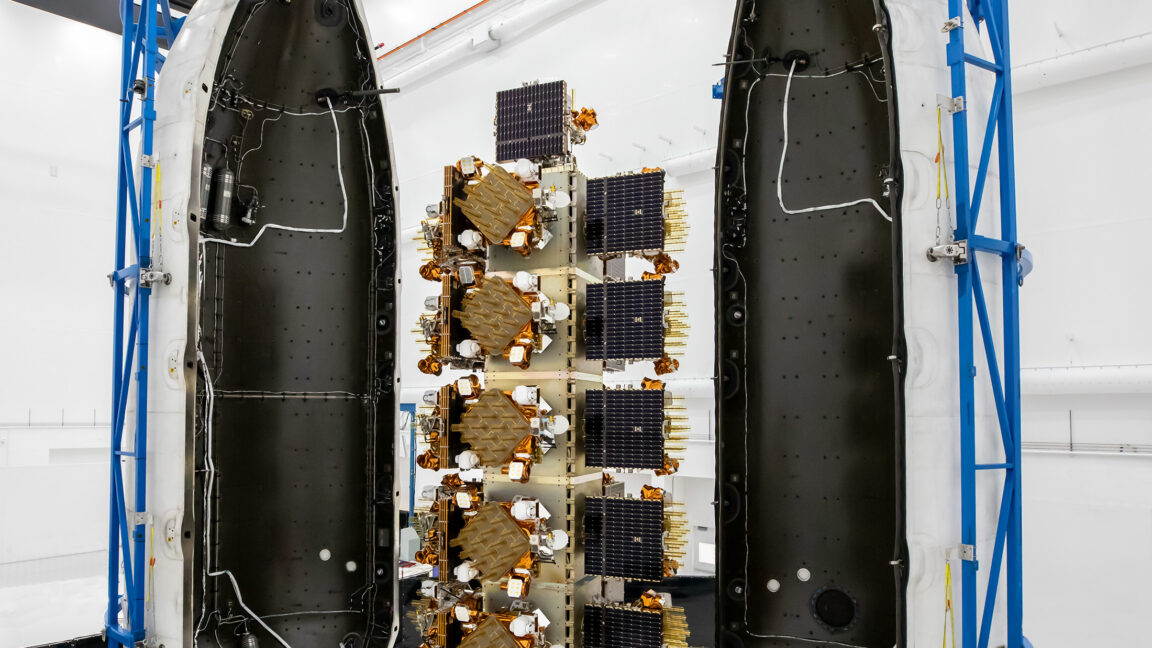
Despite these challenges, the third group of Tranche 1 data transport satellites launched on a SpaceX Falcon 9 rocket from Vandenberg Space Force Base, California. This launch brings the total number of transport satellites launched in Tranche 1 to 63. SDA Director Gurpartap “GP” Sandhoo stated that this deployment will expand warfighting capability by delivering persistent tactical satellite communication for advanced missile threat warning and tracking.
Previous launches in September and October were successful, but ground teams encountered difficulties activating and commissioning satellites, particularly those made by York Space Systems and Lockheed Martin. Issues included insufficient ground station coverage, thermal control problems, and propulsion system challenges as satellites ascended to their operational altitude of over 600 miles (1,000 kilometers). Sandhoo noted the harsh radiation environment at this altitude has complicated orbit raising.
SDA and its contractors paused launches after last year's issues to address known problems, with Sandhoo expecting the latest launch to be smoother. The Tranche 1 architecture includes 154 operational satellites: 126 for data relay and 28 for missile tracking. Seven more launches are planned to complete Tranche 1, with the tracking satellites yet to be launched. The schedule for subsequent satellite series remains constrained by the availability of optical communication terminals needed for the integrated mesh network.
SDA anticipates that the Tranche 1 satellites will provide initial warfighting capability beginning in 2027. The agency is no longer prioritizing a monthly launch cadence, focusing instead on ensuring satellites are operational as quickly as possible once in orbit.