Key facts
- A new study from NYU's Courant Institute confirms the 2024 momentum flux theory regarding sprinkler rotation.
- The research investigated the physics behind "silly sprinklers" and the reverse sprinkler problem.
- Experiments showed that reverse sprinklers rotate approximately 50 times slower than forward sprinklers.
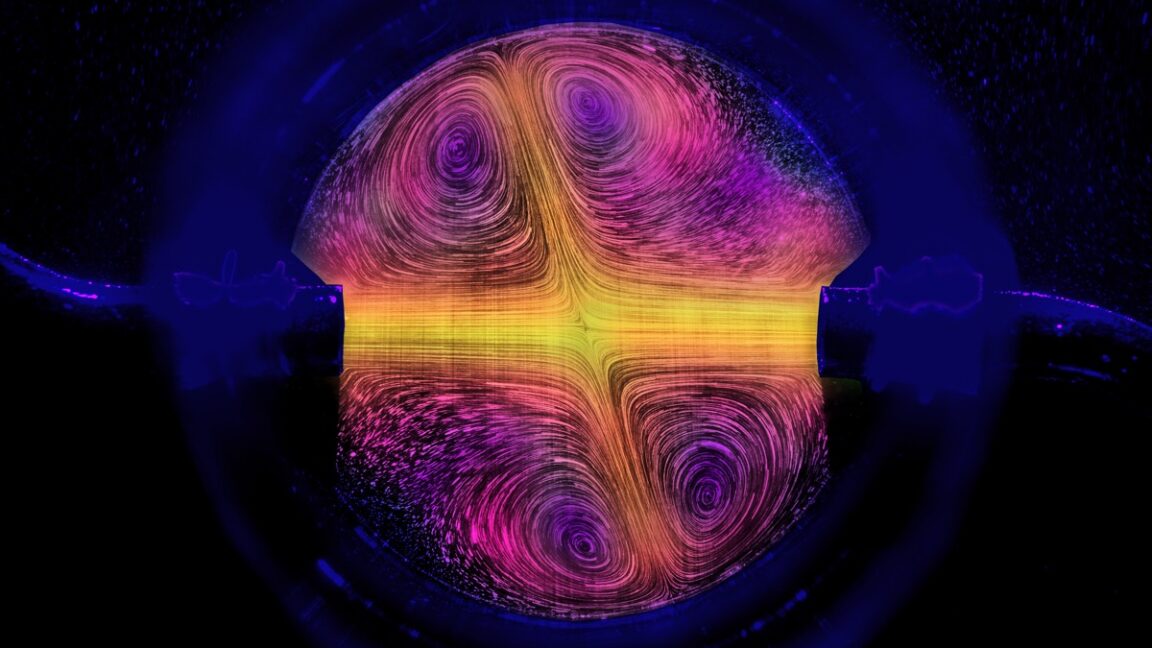
- The findings are based on observations of fluid flow patterns within custom-built, low-friction sprinklers.
- The momentum flux theory explains reverse rotation through the collision of internal water jets.
- The study's results can inform the design of devices like turbines that convert fluid flows into energy.
Researchers at New York University's Courant Institute have published findings that confirm their 2024 momentum flux theory, which explains the physics behind the rotation of sprinklers, including the long-standing "reverse sprinkler problem." The study, detailed in the Proceedings of the National Academy of Sciences, utilized custom-built sprinklers with ultra-low-friction bearings immersed in water to meticulously observe fluid flow patterns.
These experiments revealed that reverse sprinklers operate approximately 50 times slower than their forward-spinning counterparts, yet function through similar mechanisms. The momentum flux theory posits that reverse rotation is driven by internal jets of water colliding within the sprinkler's chamber, generating torque. This contrasts with earlier hypotheses from Ernst Mach and Richard Feynman, which suggested either no rotation or different mechanisms.
The NYU team's observations strongly supported their momentum flux theory and provided specific guidelines for designing structures that can control fluid flow to produce torque and rotation. This enhanced understanding of how components respond to fluid flows has potential applications in engineering future devices, such as turbines, that convert these flows into usable energy.