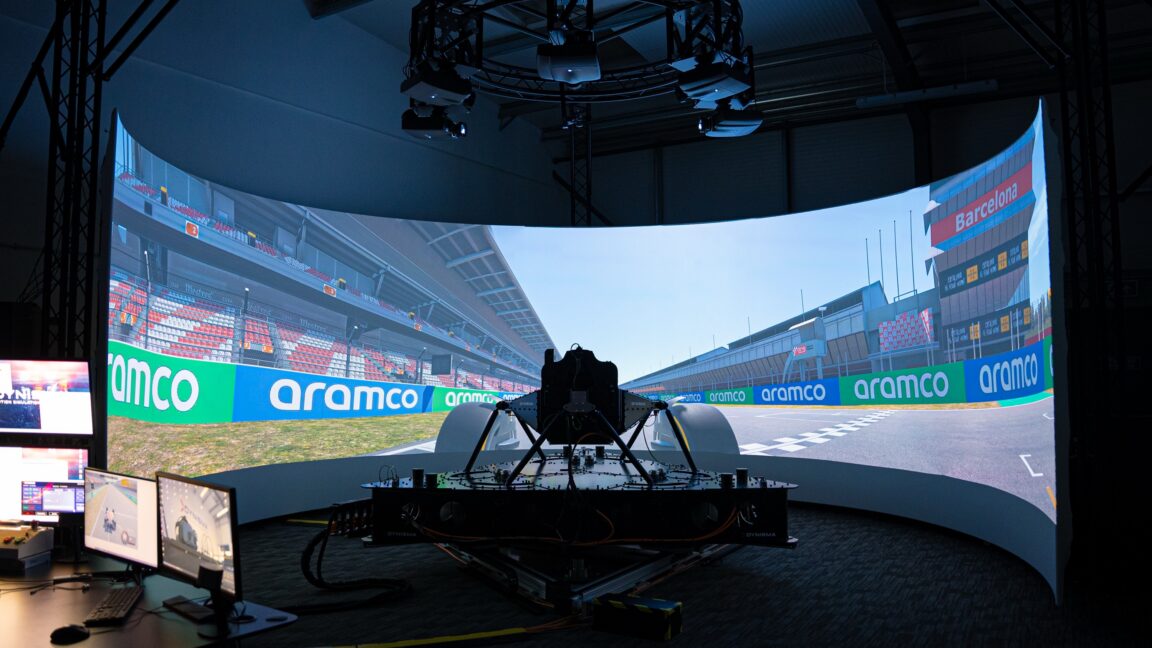
Key facts
- F1 teams spend between $3 million and $10 million on driver-in-the-loop simulators.
- These simulators aim for latency between 3 and 5 milliseconds.
- High bandwidth is essential for replicating road vibrations and tire feel.
- Sim drivers work to optimize tire wear, grip, and race car performance.
- Simulator data is correlated with real-world performance after practice sessions.
Formula 1 teams invest heavily in driver-in-the-loop simulators, with costs ranging from $3 million to $10 million, to gain a competitive edge. These advanced systems are designed for ultra-low latency, aiming for delays as low as 3 to 5 milliseconds between driver input and the simulator's response. This precision is critical for accurately replicating the dynamic behavior of a race car and providing drivers with the instinctive feedback they rely on.
Ash Warne, founder and CTO of Dynisma, a company supplying simulators to teams like Ferrari and Alpine, explained that the goal is to replicate the real car as closely as possible. He noted that even World Champion drivers can immediately detect inaccuracies. Warne, who previously worked at McLaren and Ferrari, developed his low-latency approach, initially proving the concept with hobbyist electronics before moving to industrial systems.
Beyond low latency, high bandwidth is crucial for transmitting the subtle vibrations and nuances of the road and engine that drivers need to feel. This allows for the accurate simulation of tire behavior, suspension displacement, and the overall feel of the car on the track, which is a significant challenge in simulator development.
Sim drivers like Simon Pagenaud play a vital role in optimizing car performance. Their work focuses on understanding and managing tire wear, maximizing grip, and improving overall race car efficiency. Pagenaud also works to correlate simulator data with real-world track performance and provides subjective feedback to engineers to help refine the car's setup for race weekends.