Key facts
- China's AI boom is creating a massive demand for electricity, necessitating a transformation of its power grid.
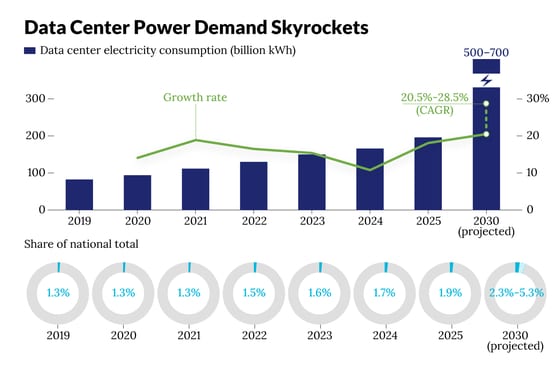
- By 2030, AI data centers could consume up to 6% of China's total grid power, potentially exceeding 10% in North America.
- The industry is transitioning from traditional 480V AC systems to 800V DC architectures with advanced transformers and cooling.
- Companies like Hisense are acquiring stakes in electrical equipment firms to offer integrated solutions for AI energy needs.
- Regional microgrids are being developed to enhance energy security and manage renewable energy volatility.
China's rapidly expanding artificial intelligence sector is creating an immense demand for electricity, prompting a significant overhaul of the nation's power grid and the electrical equipment industry. This surge in energy consumption is forcing a move away from standardized hardware towards advanced high-voltage and liquid-cooling technologies necessary for AI data centers.
Industry forecasts suggest that by 2030, AI data centers could account for as much as 6% of China's total grid consumption, with some North American regions potentially exceeding 10%. This escalating demand is driving a fundamental redesign of power distribution systems, with traditional 480V AC power systems being replaced by 800V DC architectures. These new systems utilize Solid State Transformers (SST) and medium-voltage rectifiers to manage the substantial load and minimize heat generation, representing a shift towards more sophisticated and efficient power electronics.
The market for these components is experiencing a stark division, with the low-to-medium voltage sector facing intense price competition, while the high-voltage and ultra-high voltage (UHV) sectors remain highly exclusive. In China, fewer than ten companies possess the capability to mass-produce the UHV transformers required for this next generation of infrastructure. Hisense Group is actively pursuing a strategy of vertical integration, including strategic acquisitions like a controlling stake in Dachi Electric, to encompass liquid cooling, microgrid technology, and high-voltage equipment.
This transformation is also intertwined with China's 'Dual Carbon' transition, emphasizing the synergy between renewable energy and AI compute. The development of regional microgrids, designed for independent operation and to stabilize the intermittent nature of wind and solar power, is a key component of this strategy. Chinese electrical giants aim not only for domestic dominance but also to capture a global market as other nations grapple with the energy demands of the AI revolution.