Key facts
- Bill Swearingen's noRecognition project creates AI-generated patterns to evade surveillance camera classification.
- The patterns have been tested against 11 open-source detection algorithms, including those used by Flock, Axon, and Clearview AI.
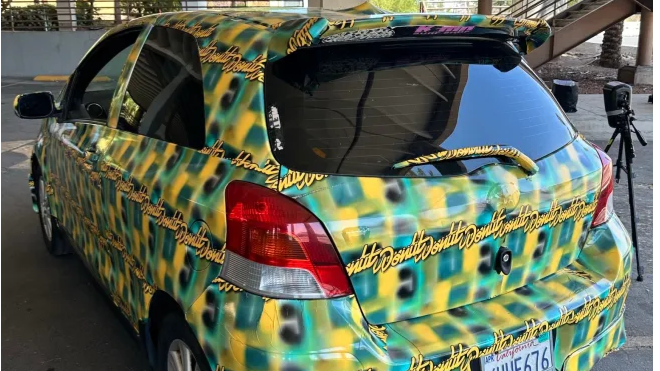
- A public demonstration at Def Con successfully used a pattern-wrapped car to evade a Flock camera.
- The patterns disrupt AI object detection without blinding the camera, making objects appear as background noise.
- Swearingen uses reinforcement learning to continuously improve and generate new patterns.
- The project aims to enhance privacy by allowing individuals to opt out of automated tracking.
Bill Swearingen has developed a project called noRecognition that utilizes AI to generate patterns designed to evade surveillance camera detection systems. These patterns work by introducing visual noise that confuses object-detection algorithms, preventing them from classifying objects such as people, faces, or vehicles. Swearingen reported that his patterns have successfully defeated all 11 open-source detection algorithms he tested, including the software used by Flock license plate readers, Axon body cameras, and Clearview AI.
A public demonstration of the technology occurred at Def Con in Las Vegas, where a 2009 Toyota Yaris wrapped in one of Swearingen's patterns was driven past a Flock camera. Swearingen stated that the test proved the effectiveness of his method, although challenges with the wheels were noted. The patterns do not blind the cameras; footage is still recorded and viewable by humans, but the AI layer fails to log the presence of the object.
Swearingen explained that this technique is a form of adversarial machine learning, where visual patterns that appear as graphic design to humans are rendered as insignificant to AI classifiers. He developed the patterns using a reinforcement learning model that iteratively improves its output. The strongest patterns are kept offline to prevent camera vendors from training their systems against them. Swearingen views these patterns as a tool for individuals to opt out of being tracked, emphasizing privacy as a fundamental right.
While improvisations against detection systems have existed for years, Swearingen's project specifically targets widely deployed systems like Flock, which is facing increasing scrutiny. The project is currently running a crowdfunding campaign to produce merchandise, including T-shirts and hoodies, with the goal of creating designs that are both effective at a distance and wearable.