Key facts
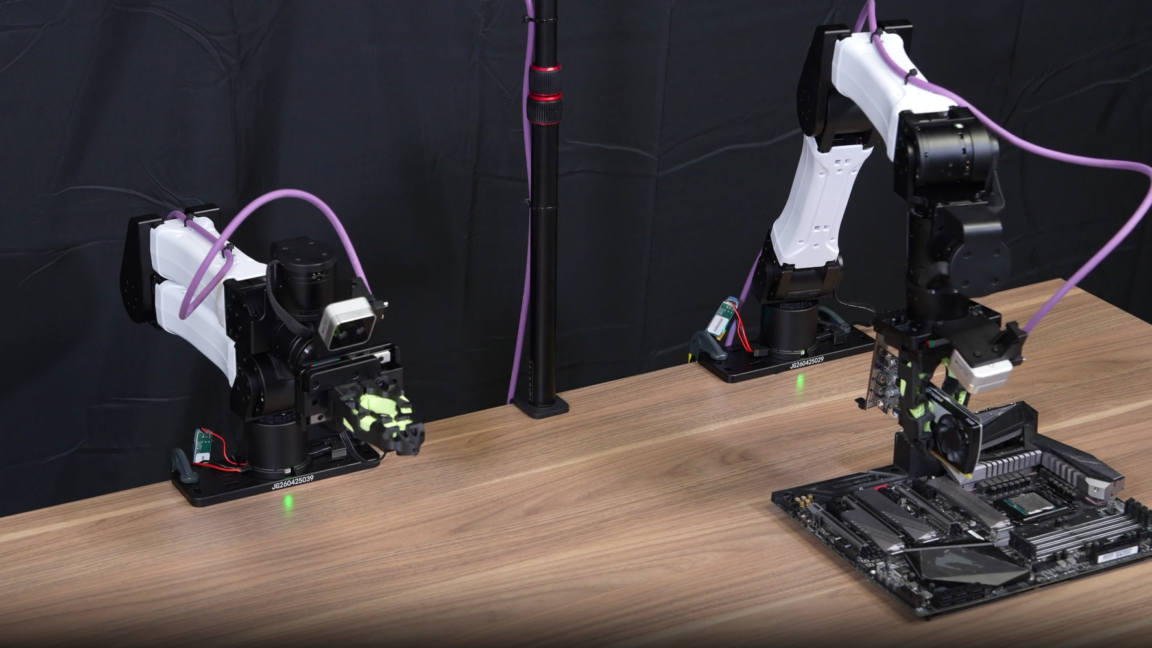
- AI coding agents can autonomously train robots for tasks like cutting zip ties and inserting GPUs into motherboards.
- NVIDIA researchers, along with collaborators from Carnegie Mellon University and UC Berkeley, developed the ENPIRE framework.
- ENPIRE utilizes four modules for task reset, policy refinement, evaluation, and failure analysis.
- The system achieved a 99% success rate across several manipulation tasks, including the 'Push-T' task and GPU insertion.
- AI agents using ENPIRE completed the 'Push-T' task faster than human-in-the-loop methods.
- Limitations include idle robot time, high token consumption, and underutilization of compute resources.
Nvidia, in collaboration with Carnegie Mellon University and UC Berkeley, has introduced ENPIRE, a framework that enables AI coding agents to autonomously train robots. This system allows AI models to manage the entire robot training process, from writing code to testing and refining it on physical hardware, without human intervention.
The ENPIRE framework splits the training into two stages. Initially, a human guides the AI agent to build two essential tools: a reset routine to return the workspace to a default state and a reward function that uses camera footage to score task success. Once these tools are established, the AI agent takes full control.
It searches research papers for training ideas, selects methods like imitation learning or reinforcement learning, and then rewrites and tests its own code on the robot. This autoresearch loop, previously confined to simulations, is now applied to physical robots. The system trades progress among a fleet of eight robot arms using Git, allowing successful strategies to spread rapidly.
Experiments showed that scaling from one robot to eight significantly reduced the time needed to master tasks such as 'Push-T' and pin insertion. Across four real-world tasks, the agents achieved a 99% success rate, surpassing human-in-the-loop methods in speed for pin insertion. However, limitations were noted, including idle robot time and high token consumption.