Key facts
- President Lee Jae Myung orders full government mobilization for heatwave.
- South Korea's heatwave has caused over 20 deaths.
- Temperatures are expected to peak near 40 degrees Celsius.
- Supreme Court will rule on insurrection trials for Han Duck-soo and Lee Sang-min.
- Han Duck-soo and Lee Sang-min are accused in relation to martial law imposed in December 2024.
- Jang Dong-hyeok criticized President Lee over Criminal Procedure Act revision.
- The revision strips prosecutors of investigative powers.
- Police seek arrest warrants for four student activists.
- The activists allegedly trespassed onto U.S. K-55 Osan Air Base.
- Activists protested U.S. military interference and a white phosphorous leak.
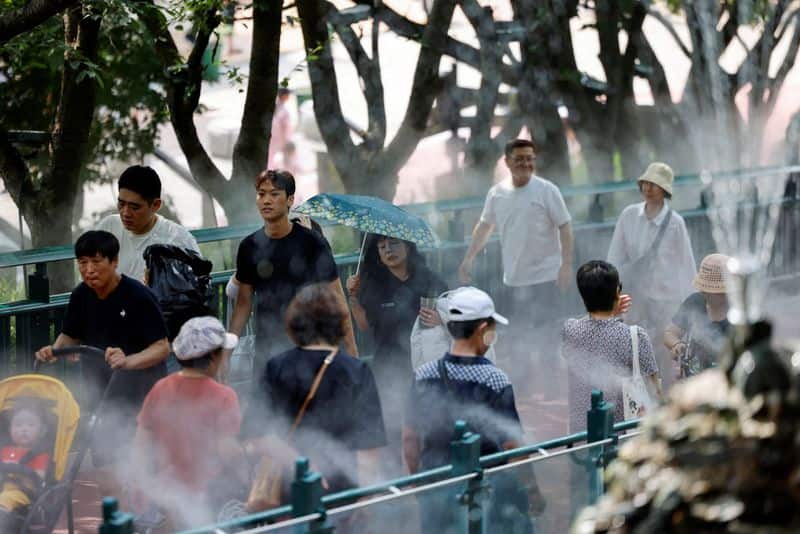
South Korea faces a confluence of domestic challenges, including a severe heatwave, ongoing legal battles, and political disputes. President Lee Jae Myung has directed a "full mobilization" of government resources to address the extreme heatwave, which has inflicted widespread damage and claimed over 20 lives, with temperatures anticipated to reach nearly 40 degrees Celsius.
In parallel, the nation's Supreme Court will convene its full bench to adjudicate the insurrection trials of former Prime Minister Han Duck-soo and former Interior Minister Lee Sang-min. They are accused of significant involvement in former President Yoon Suk Yeol's brief imposition of martial law in December 2024. This legal proceeding highlights a critical period in the country's recent political history.
Politically, the leader of the main opposition People Power Party (PPP), Jang Dong-hyeok, has publicly criticized President Lee Jae Myung. The criticism stems from President Lee's remarks suggesting he had not read a revision to the Criminal Procedure Act, which curtails prosecutorial investigative powers, despite having approved its promulgation. This exchange underscores ongoing tensions between the executive and legislative branches.
Further complicating the domestic landscape, South Korean police have requested arrest warrants for four student activists. These activists are alleged to have trespassed onto the U.S. K-55 Osan Air Base. Their actions were reportedly part of a protest against alleged U.S. military interference in a semiconductor project and a recent white phosphorous leak.