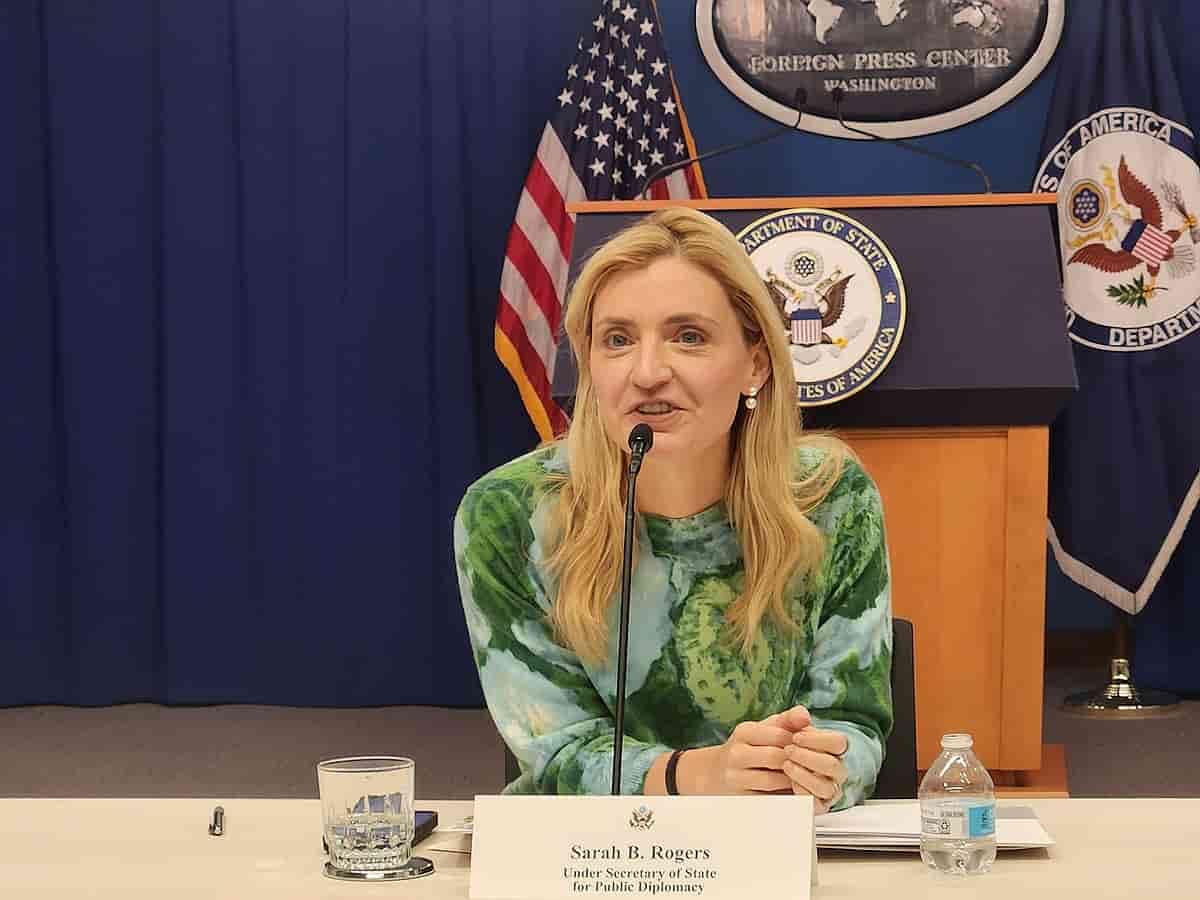
Key facts
- Sarah Rogers, nominee to lead the U.S. Agency for Global Media (USAGM), testified before the Senate Foreign Relations Committee.
- Rogers highlighted the impact of free information, citing North Korean defectors who risked death to flee their country after hearing about freedom through American radio.
- She stated that USAGM, which oversees Voice of America and other government broadcasters, can be an indispensable tool of American foreign policy.
- Rogers vowed to spearhead "truth-telling" efforts if confirmed.
- In her current role as under secretary of state for public diplomacy, Rogers oversees a $1 billion budget aimed at advancing U.S. foreign policy and countering propaganda.
Sarah Rogers, the nominee to lead the U.S. Agency for Global Media (USAGM), emphasized the critical role of free information in closed societies during her confirmation hearing before the Senate Foreign Relations Committee. Rogers recounted her engagement with North Korean defectors during a visit to South Korea in April, who shared that snippets of American radio were their first indications of an alternative life.
Rogers stated that these defectors risked torture and death to flee toward a freedom they only heard existed, underscoring the impact of broadcasts from Voice of America (VOA) and its grantees. She described these outlets as indispensable instruments of American foreign policy.
If confirmed, Rogers would lead USAGM, which oversees VOA and other government broadcasters, and also funds outlets like Radio Free Asia. In her current capacity as under secretary of state for public diplomacy, she manages a workforce of over 5,000 employees and a $1 billion budget dedicated to advancing U.S. foreign policy and countering propaganda from nations including North Korea, China, Russia, Iran, and Cuba. Rogers has indicated she would hold both roles concurrently if confirmed.
During the hearing, Rogers stressed that "truth-telling" is the core mission of USAGM. She noted her extensive travel, covering more than 70,000 miles in the past year, which has provided firsthand evidence of free information's power in closed societies. She concluded by stating that "free people tend to choose America, and the truth sets people free," drawing a parallel to how delivering truthful information helped defeat Soviet communism and asserting that "truth remains America's best tool" in today's information warfare.