SEOUL, Aug. 6 (Yonhap) -- South Korea's Unification Ministry affirmed on Thursday its commitment to pursuing peaceful coexistence with North Korea, vowing to continue efforts to achieve tangible results despite a challenging geopolitical climate. The ministry stated, "The ministry will continue efforts for peaceful coexistence with North Korea to bear fruit, keeping in mind the president's call for patience." It emphasized the necessity of "ceaseless" efforts to "create even the smallest opportunity to bring peace in challenging conditions," adding, "Nothing will happen if we stay put."
This statement follows President Lee Jae Myung's cautious remarks on the ministry's proposed initiatives during a policy briefing. These proposals include removing the designation of North Korea as the "main enemy" and referring to it by its official name, the Democratic People's Republic of Korea, as part of a broader trust-building strategy. South Korea currently uses "North Korea" rather than its official name, a practice stemming from the 1991 Inter-Korean Basic Agreement.
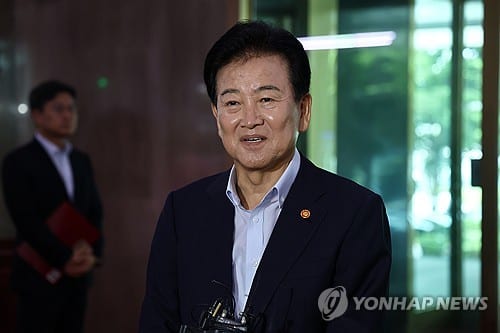
Unification Minister Chung Dong-young defended his ministry's peace initiative, stating that President Lee had expressed support for the effort, albeit with a call for patience. "The president said it must feel like a cry that goes unanswered," Chung remarked. "But he told us to keep working toward peaceful coexistence, and to be patient."
However, the ministry's approach has raised concerns about the Lee administration adopting a potentially too-dovish stance towards North Korea, which has shown no reciprocal signs of easing tensions. During a briefing, President Lee cautioned that well-intentioned policies could be exploited for political gain, urging careful consideration.
Adding to the apparent internal division, Foreign Minister Cho Hyun expressed skepticism regarding Chung's North Korea initiatives, describing them as "idealistic." Cho stated, "It would be great if that vision came true. But realistically, our ministry does not see it as achievable," and noted that the unification ministry's proposal for a four-way dialogue involving the two Koreas, the United States, and China had not been coordinated government-wide.
Minister Chung countered that idealism is necessary to change reality, asserting, "I believe we can help move the government forward when we cooperate with each other." The Unification Ministry echoed this sentiment, characterizing its approach not as idealism but as "the most realistic and practical approach at this moment."