Key facts
- A German regional court ruled that comparing Israel to Nazi Germany is protected political speech.
- The ruling acquitted a woman previously convicted for social media posts making such comparisons.
- Germany has recently banned Hamas and Samidoun, a Palestinian advocacy group.
- Over 60% of Germans now favor European sanctions on Israel.
- The court decision emphasizes that constitutional principles, not political commitments, should guide legal judgments on speech.
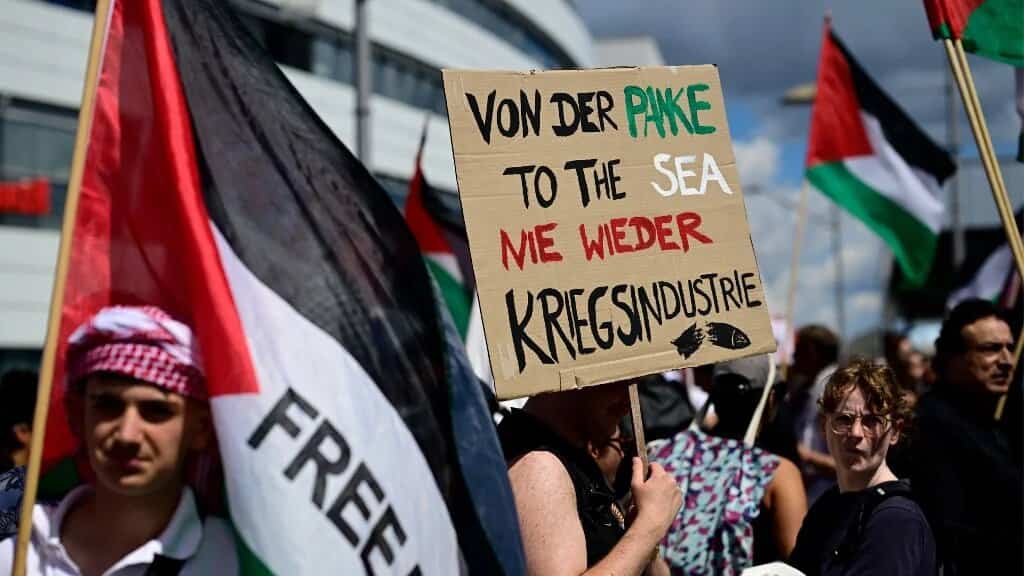
A German regional court has ruled that comparing Israel to Nazi Germany constitutes protected political speech, a decision that challenges the German government's strong political commitment to Tel Aviv and highlights a growing conflict with constitutional protections for free expression. The court acquitted a woman who had been convicted in a lower court for social media posts that likened Israel's actions in Gaza to the methods of the Nazi regime.
In recent years, Germany's support for Israel has increasingly influenced domestic governance, including administrative decisions and criminal prosecutions. Following the October 7, 2023, attacks, Germany banned Hamas and the Palestinian advocacy group Samidoun, employing laws originally intended to prevent a Nazi revival to curb criticism of Israel. The recent ruling, however, rejected the prevailing notion that such analogies are inherently criminal, affirming that political expression, even when controversial, is protected under constitutional standards.
The decision comes amidst ongoing international discussions about alleged Israeli actions in Gaza, including International Criminal Court warrants against Israeli politicians and pending cases at the International Court of Justice. Public opinion in Germany has also shifted, with a significant majority now favoring European sanctions against Israel. Historically, comparisons between Israel and Nazi Germany have been part of academic and philosophical debates, particularly concerning the interconnectedness of the Shoah and the Nakba, and have raised questions about historical responsibility and inherited guilt.
The court's judgment implicitly pushes back against attempts to elevate Germany's foreign policy objective of supporting Israel into a quasi-constitutional principle that restricts political speech. It reasserts the autonomy of constitutional law over executive preferences and political doctrines. The article suggests that judges have a moral obligation to avoid using government ideology to suppress dissenting opinions, especially given Germany's history of judicial complicity in state persecution. Criminal proceedings related to Palestine are increasingly becoming symbolic arenas for negotiating national identity and historical memory, with courtrooms serving as spaces where differing interpretations of history and democracy are contested.