Key facts
- Over 1,500 individuals facing terrorism charges related to Palestine Action protests had their cases listed for hearings in London.
- Conflicting court notices caused confusion among defendants regarding attendance.
- The Supreme Court ruled that Palestine Action could challenge its ban.
- Defend Our Juries (DOJ) criticized the court's handling of the cases as "unlawful" and "chaos".
- London police issued a statement downplaying the significance of the court listings.
Chaos erupted in London on Thursday as over 1,500 individuals facing terrorism charges in connection with Palestine Action protests had their cases listed for hearings, leading to significant confusion and disruption. The campaign group Defend Our Juries (DOJ) reported that many defendants, initially informed of postponements to October, were unexpectedly listed for hearings on July 30.
Notices sent to defendants contained contradictory information, with some instructed to attend a hearing while simultaneously being told not to. This confusion was described by DOJ as symptomatic of the "chaos" unleashed by the ban on Palestine Action, which they claim has sent the criminal justice system into "complete meltdown".
On Thursday, the Supreme Court ruled that Palestine Action could challenge its ban, which was imposed by the former Prime Minister Keir Starmer's government. The proscription has led to thousands of arrests over the past year.
Defendants arriving at Westminster Crown Court on Thursday described milling around with their notices and receiving conflicting explanations from court staff. One defendant stated her hearing was listed for a non-existent courtroom. Letters addressed "To Whomever it May Concern" informed parties that attendance was not mandatory for an administrative hearing on October 26.
Lawyer Tim Crosland criticized the court's communication methods, stating it was "crazy" and not how the court system is meant to work. He suggested the court was attempting to process a large number of people like a "sausage machine" to avoid practical problems.
London's Metropolitan police issued a statement calling a planned protest outside the court "nonsensical" as "no hearings related to Palestine Action" were taking place. DOJ responded by questioning the police's information source and emphasizing that court adjournments should be communicated by the court directly to the parties.
Several defendants shared their experiences of confusion and the impact of the charges on their lives. Tony, a contractor, explained that his terrorism charge prevents him from traveling to the US to see his family and affects his ability to secure work. Bernie and Heather traveled eight hours for hearings that had been adjourned, only to find their names listed again.
Marji, a DOJ spokesperson, was listed for three hearings with different spellings of her name and questioned the lack of access to court, asking, "So are there secret courts?". Miriam, facing five charges under the Terrorism Act, noted that only three of her cases had received adjournment letters, while four were listed for the current day.
Clive Dolphin, a DOJ spokesperson, described the court's handling of the cases as "unlawful," emphasizing that each case is different and cannot be treated as a "block booking." He explained that Section 13 of the Terrorism Act, under which many are charged, requires individual assessment of circumstances.
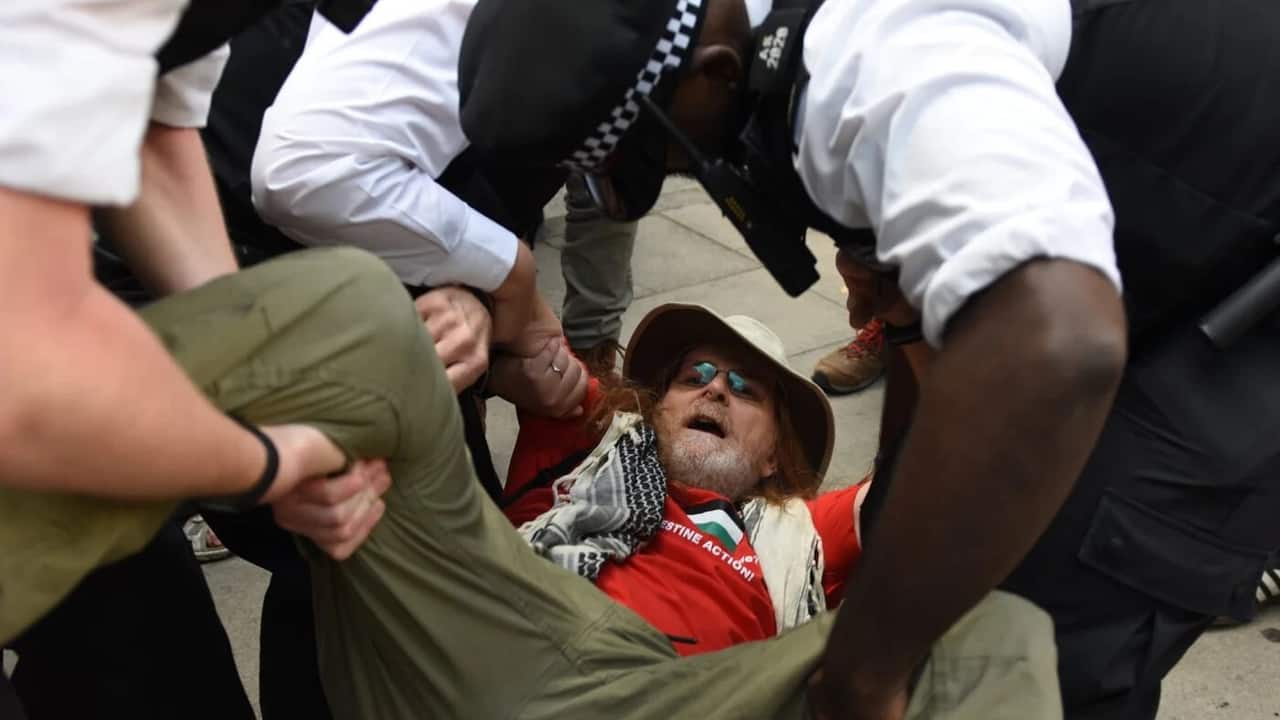
Outside the court, police began arresting protestors who staged a sit-in, with approximately 200 people risking arrest under Section 12 of the Terrorism Act for reading statements inviting support for Palestine Action.