Key facts
- 14 nations, including the US and UK, reaffirmed a 2016 arbitral ruling invalidating China's claims in the South China Sea.
- The European Union also reaffirmed the ruling as legally binding.
- China rejected the ruling, calling it null and void.
- The joint statement opposed destabilizing actions and the use of forces to harass lawful operations in the disputed waters.
- The US reiterated its treaty obligation to defend the Philippines in case of an armed attack in the disputed waters.
Fourteen nations, including the United States and the United Kingdom, jointly reaffirmed a 2016 arbitral ruling that declared China's extensive claims in the South China Sea to be illegal. The European Union, comprising 27 member states, issued a separate statement supporting the ruling as a historic decision for peaceful dispute resolution.
The joint statement emphasized opposition to "destabilizing" actions in the disputed waters that threaten regional stability and reiterated that the 2016 ruling by an arbitral tribunal under the UN Convention on the Law of the Sea (UNCLOS) is "definitive and legally binding."
China, however, reiterated its stance that the ruling is "null and void and has no binding force," stating that Beijing "neither accepts nor recognizes it." China refused to participate in the arbitration initiated by the Philippines in 2013 and continues to assert claims over nearly the entire maritime passage, a critical global trade route.
The countries signing the statement, in addition to the US and UK, included the Philippines, Japan, Australia, New Zealand, Canada, Germany, Italy, Estonia, Latvia, Lithuania, Romania, and Slovenia. They expressed firm opposition to "any unilateral action, even by force or coercion, that threatens peace and stability in the region."
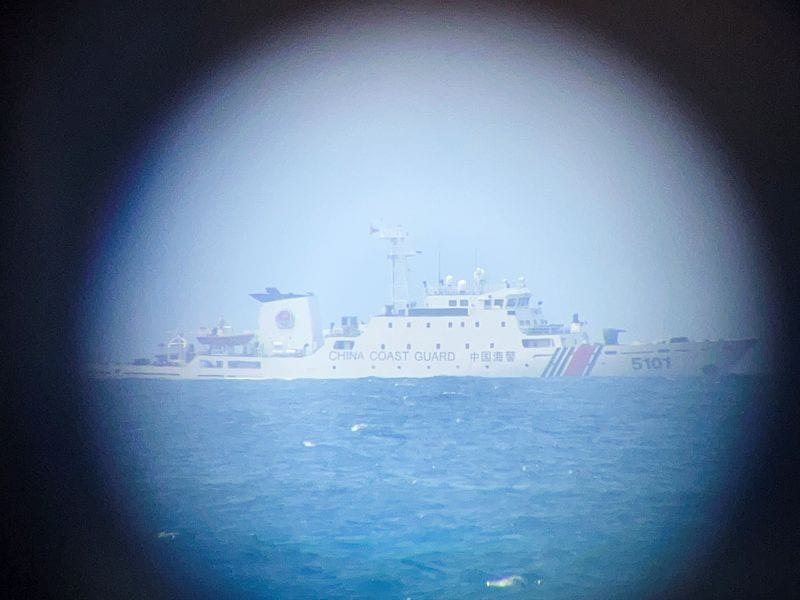
The statement also condemned the use of coast guard, military, and maritime militia forces to "harass, impede or intimidate lawful operations of other states" and to "severely degrade regional peace and security." The nations underscored the need to maintain freedom of navigation and overflight, and to resolve territorial disputes peacefully based on the 1982 UNCLOS.
China's Ministry of Foreign Affairs stated that the arbitral tribunal and its ruling "gravely contravene the general practice of international arbitration" and "gravely violate China's legitimate rights as a sovereign state and as a party to the UN Convention on the Law of the Sea, and are unjust and illegal."
Recent years have seen increased territorial confrontations, particularly between Chinese and Philippine forces, involving water cannons, military lasers, and dangerous blocking maneuvers. The United States has repeatedly urged China to comply with the arbitral ruling and has warned that Washington is obligated to defend the Philippines, its oldest treaty ally in Asia, if Philippine forces face an armed attack in the disputed waters.