Key facts
- Unitree Robotics shares surged 629% on their Shanghai IPO debut.
- The company raised $905 million in its initial public offering.
- Unitree Robotics shares opened at 1,100 yuan.
- The market for humanoid robots is projected to grow rapidly.
- Chery's robot unit, AiMOGA Robotics, is preparing for an IPO.
- Global humanoid robot shipments nearly quadrupled in the first half of this year.
Unitree Robotics shares surged 629% on their Shanghai IPO debut, opening at 1,100 yuan and raising $905 million. The listing on the tech-focused Star Market is considered a milestone for China's robotics sector, a key area of technological competition with the U.S.
Investors are actively seeking winners in robotics development, a critical battleground in the AI race. Unitree, founded in 2016, shipped over 5,500 humanoid robots last year. The market for human-like robots is expected to grow rapidly, with sales projected to increase from around $2 billion in 2025 to $300 billion by 2035.
There was exceptional demand from Chinese retail investors for Unitree's IPO, with the shares allocated to non-professional investors oversubscribed by thousands. Unitree is one of the few publicly listed humanoid robot makers globally. Its competitors include AgiBot (private) and UBTech (listed in Hong Kong).
At least half a dozen other Chinese humanoid robotics businesses, such as Deep Robotics and Leju Robotics, are preparing to go public. Wang Xingxing, Unitree's founder and CEO, owns about a fifth of the company, making his personal wealth over $12 billion on paper following the share price spike.
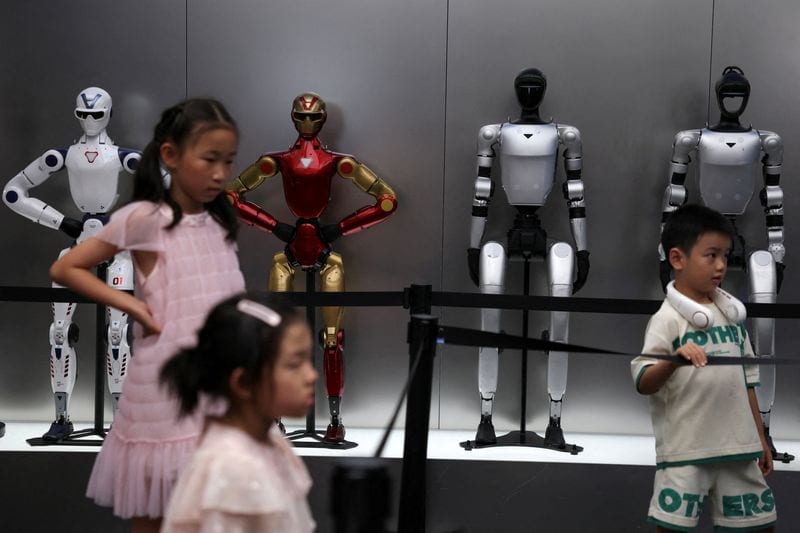
The company's market debut coincided with the opening of the World Robot Conference in Beijing, where over 300 companies showcased their latest machines. Xin Guobin, vice minister of the Ministry of Industry and Information Technology, pledged support for the sector, calling robotics an "important force" in China's development. While robots are increasingly deployed in logistics and on assembly lines, large-scale adoption beyond pilot projects remains limited. Some companies, like Leju, report their robots achieve the same efficiency as human workers in tasks like moving and sorting crates. Startup Robotera demonstrated a parcel-sorting humanoid robot with a continuous running time of 900 to 1,000 hours, achieving 85% of human effectiveness. Other exhibits included packaging robots and a robotic horse. UBTECH showcased teaching robots for English classes and exam supervision.
The industry's rapid expansion mirrors China's electric vehicle sector, with many companies emerging quickly. Zhang Guibing, head of AiMOGA Robotics, Chery's robotics division, noted that while this leads to intense competition, it ultimately helps deepen the industry's technology and capabilities. Global humanoid robot shipments nearly quadrupled in the first half of this year to 19,100 units, with Chinese manufacturers dominating the market. However, an estimated 50% to 70% of humanoid robots produced this year could be used in "data factories" for training data rather than productive work. Analysts suggest humanoid robots could take about a decade to mature before seeing rapid adoption, with competition in the Chinese market expected to become extremely intense, especially regarding costs.