Key facts
- UK house prices were flat in June, with the average price falling by £540 to £277,484.
- Annual UK house price growth increased to 2.2% in June.
- U.S. construction spending rose 0.1% in May, below economists' forecasts.
- U.S. residential construction investment increased 0.3%, but new single-family home projects fell 0.1%.
- Higher mortgage rates, influenced by the Middle East conflict, are impacting U.S. homebuilding.
- Northern Ireland showed strong annual house price growth at 8.6%.
UK house prices remained flat in June, with the average price experiencing a slight decrease of £540 to £277,484. This stagnation is attributed to subdued consumer confidence stemming from the ongoing conflict in the Middle East, coupled with soaring energy prices and interest rates. The Royal Institution of Chartered Surveyors noted a significant drop in new buyer enquiries and a noticeable fall in mortgage approvals during May.
Despite the monthly flatness, annual house price growth saw a modest increase, rising to 2.2% in June from 1.7% in the previous month. Analysts are cautiously optimistic about a potential market recovery, particularly as a memorandum of understanding between the US and Iran has helped to lower oil prices and ease the energy shock. Robert Gardner, chief economist at Nationwide, suggested that if the energy shock continues to subside and UK inflation remains lower than expected, the Bank of England might not need to raise interest rates as aggressively as previously anticipated.
This shift in market expectations has contributed to lower market interest rates, which underpin mortgage pricing. Gardner indicated that sustained positive trends could restore household confidence and improve affordability, paving the way for increased housing market activity in the coming quarters, provided domestic political uncertainty does not negatively impact sentiment. Tom Bill, head of UK residential research at Knight Frank, echoed this, noting that stabilizing energy markets and slightly lower mortgage rates should support demand.
However, concerns remain about the fragility of consumer confidence and the lingering effects of the conflict. Ian Futcher, a financial planner at Quilter, warned that soft market activity might persist. Industry figures also highlighted the resilience of the housing market throughout the conflict, with the Bank of England's decision to hold interest rates steady for the past four meetings providing a stabilizing effect. Lenders are beginning to trim mortgage rates, offering some relief to buyers concerned about affordability.
In contrast to the national trend, Northern Ireland once again stood out with robust annual price growth of 8.6%, reaching £226,699. This performance significantly outpaced the North West region's 3.9% growth. East Anglia and the outer South East were the only regions to record price declines, falling by 0.4% and 0.7% respectively.
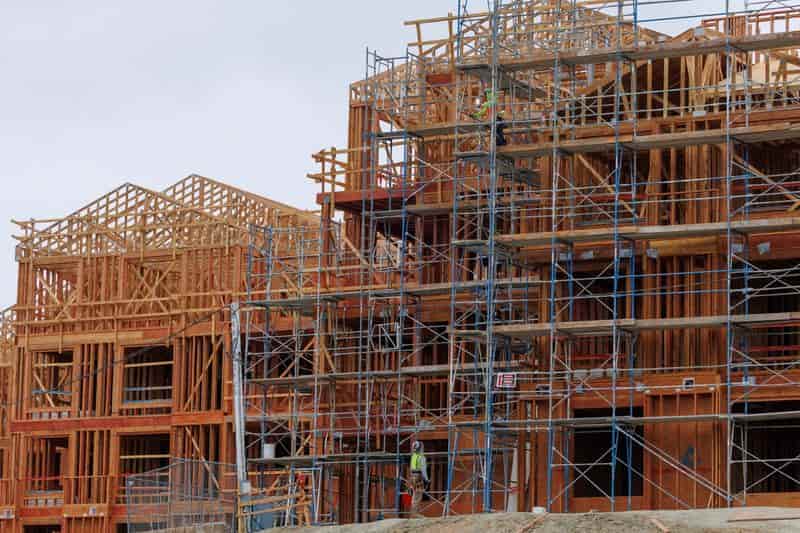
In the U.S., construction spending edged up 0.1% in May, falling short of economists' expectations. This marginal increase followed a revised 0.3% gain in April. Investment in residential construction rose 0.3%, primarily driven by renovations, while spending on new single-family housing projects declined 0.1% and was down 4.0% year-over-year. The ongoing conflict in the Middle East has boosted oil prices, contributing to inflation and higher mortgage rates, which have averaged 6.49% for a 30-year fixed mortgage. Spending on multi-family housing units dipped 0.1%, and private nonresidential construction declined 0.3%. Public construction projects saw a 0.5% increase.