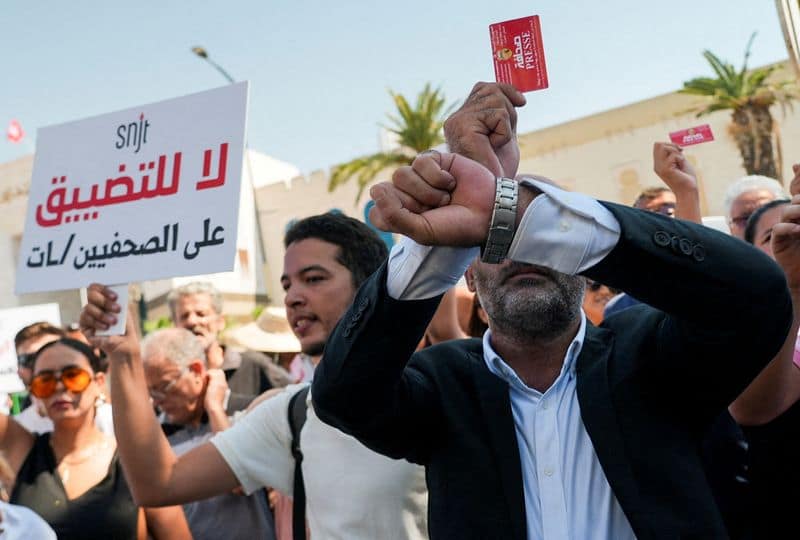
Key facts
- Journalists in Tunisia face renewed threats of imprisonment and a crackdown on press freedoms.
- Around 20 journalists face criminal charges, with four already imprisoned.
- President Kais Saied's government is accused of eroding press freedoms gained after the 2011 Arab Spring.
- Tunisia ranks 137th in Reporters Without Borders' press freedom index, a significant drop.
- Journalists report receiving threats, judicial restrictions, and facing charges such as illicit enrichment and spreading false news.
Journalists in Tunisia are experiencing a significant erosion of press freedoms, with many fearing imprisonment for their work, according to a Reuters report. Following the 2011 Arab Spring, which ushered in a period of media liberation, President Kais Saied's consolidation of power has led to a crackdown on independent media.
Rights groups state that Tunisia has fallen over 50 places in the past five years to 137th in Reporters Without Borders' press freedom index. Aymen Rezgui, editor-in-chief of the independent outlet Nawaat, described the current situation as a "shifting minefield" where limits are unclear, unlike the pre-2011 era.
Around 20 journalists are currently facing criminal charges related to their reporting or social media activities, and four are already imprisoned, according to Zied Dabbar, head of the National Syndicate of Tunisian Journalists. President Saied maintains he is not a dictator and that journalists are free to criticize authorities, while authorities state prosecutions are impartial judicial matters.
Nawaat has faced threats from government supporters and judicial restrictions, including a one-month suspension order last year. Other journalists report similar pressures. Mohamed Yousfi, editor-in-chief of Al-Qatiba, was arrested and charged with illicit enrichment, which he denies. Prominent broadcasters Mourad Zeghidi and Borhen Bsaies are also jailed on charges including tax evasion, which they deny.
Some journalists have chosen exile to avoid prosecution. Khaoula Boukrim, founder of Tumedia, left for France fearing arrest and was later sentenced in absentia to four years in prison. Haythem Mekki also left Tunisia after receiving a prison sentence for public comments denouncing conditions in a hospital morgue.
Press freedom advocates argue that prosecutions are being used to intimidate critical voices. Journalists are also frequently prevented from working by police, and international correspondents have been denied accreditation. Critical programs have disappeared from private radio stations, and state media has marginalized dissenting voices, though the TAP state news agency remains an exception.
Zied Heni, a radio journalist, was sentenced to a year in prison for criticizing a judicial ruling. His wife, Thouraya Zouari, described his detention as a "nightmare" but expressed determination to continue the struggle for freedom of expression.